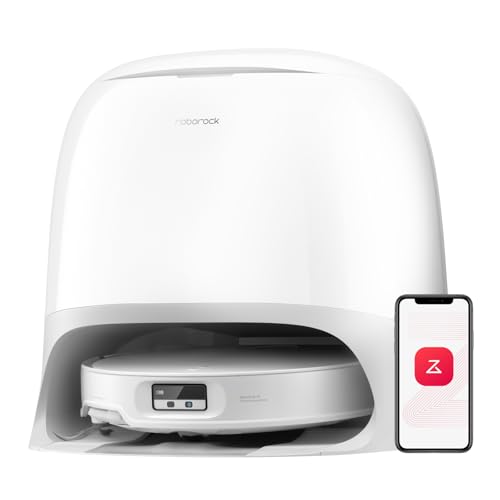
Hardwood, laminate and tile are the easiest surfaces to clean and the easiest to get wrong. The risks are water, grit and a cliff sensor that cannot read a dark floor.
Disclosure — some links on this page go to Amazon, and we earn a commission if you buy through them. It costs you nothing extra and it does not change what we recommend or in what order. The full disclosure.
On hard floors the vacuuming is the easy part. What separates models is the mop: whether it lifts high enough to stay off adjoining carpet, whether it washes itself during the run or only at the dock, and whether the robot's cliff sensors can read your floor color at all.
Hardwood, laminate, engineered board, vinyl plank and tile all behave much the same to a vacuum — though they differ sharply once a mop is involved, which is why vinyl plank has its own page. Debris sits on the surface rather than sinking into a pile, so even a modest suction figure picks it up. This is the one part of the category where the number on the box genuinely does not matter much.
Three things do matter, and none of them is suction: what the brush does to the finish, what the mop does to the boards, and whether the robot can see the floor.
Grit is what actually scratches a floor
A robot vacuum does not scratch hardwood. Grit carried under a robot vacuum scratches hardwood, in exactly the way grit under a shoe does. The practical consequence is that running the robot more often is protective rather than risky: the less time sand and grit spend on the floor, the less time they spend being ground into the finish.
Brush material is the secondary question. Rubber and silicone rollers are gentler on a soft finish than stiff bristles, and they also handle hair better, which is why almost every current flagship uses one. Where a maker publishes the material we have recorded it; where they do not, we have said so. The full treatment of both worries — the floor and the baseboards, which are different problems — is on scratched floors and scuffed baseboards.
Main brush construction, by model
7 of 7 models publish this figure. Every number below links to the page it came from.
Compiled from the manufacturers’ own published material — every row carries the date its figure was read. We have not measured any of these figures ourselves, see how we pick. Found an error? Tell us and we will correct it.
Water is the real risk, and mop lift is the spec
Sealed hardwood, laminate and vinyl all tolerate a damp mop and none of them tolerates standing water. The robot's job is to leave the floor damp, not wet, and to get the wet pad off the floor before it reaches anything absorbent. That second job is what the mop-lift figure measures.
Published mop lift height
12 of 29 models publish this figure. Every number below links to the page it came from.
The highest mop lift figure on this site; the next highest published anywhere here is the 17mm Roborock states for the Qrevo CurvX and the Saros 10R. eufy states the chassis also raises for carpet up to 2in thick, but its regional pages disagree on that limit so it is not relied on.Source: eufy Omni S2 US product page — mop lift (retrieved 2026-10-17)
CONTESTED. eufy's E28 page says the mop lifts for carpet but gives no height; its US buying guide says 20mm and its FAQ says 12mm. Where a maker states two different figures for one machine we publish neither.
Compiled from the manufacturers’ own published material — every row carries the date its figure was read. We have not measured any of these figures ourselves, see how we pick. Found an error? Tell us and we will correct it.
Published lifts cluster between 10mm and 17mm. Roborock's 17mm is the highest here; ECOVACS states 10mm; iRobot sidesteps the whole question by retracting the pad onto the top of the robot, which is the only design that removes the pad from the floor plane entirely. Several models publish nothing at all — including some that advertise auto mop lifting in their own marketing copy. The full comparison is on mop lift height compared.
The dark-floor problem
This one catches people out and it has nothing to do with cleaning. Robot vacuums use infrared cliff sensors pointed at the floor to avoid driving down stairs. A dark, matte or high-gloss black floor can absorb or scatter that infrared to the point where the sensor reads it as a drop. The robot then refuses to cross a perfectly flat floor, reverses, and reports itself trapped.
It is a well-documented failure mode, it varies by model, and no manufacturer publishes a specification for it. There is a fix, and it is on robot vacuums and dark floors For choosing a machine rather than fixing one, best robot vacuums for hardwood floors ranks on the brush and the mop dock, and best robot vacuums for pet hair on hardwood covers the case where something sheds onto it. — the single most useful page on this hub if it applies to you.
Quick picks
Ranked on the published specifications below. Tap a row to jump to the full write-up.
#
Product
Best for
Mop lift
Price
1
ECOVACS DEEBOT X9 PRO OMNIThe roller mop that washes itself continuously while it runs rather than pushing one increasingly dirty pad around, now with a cyclone-directed anti-tangle brush.
Roborock Qrevo CurvXThe highest published suction figure here paired with the highest published mop lift, which is the combination a mixed-floor home actually needs.
eufy X10 Pro Omnieufy publishes an obstacle clearance, a mop lift, two runtimes and both tank capacities — more of its own numbers than any other maker here.
Roborock Q7 M5Proper 360-degree LiDAR mapping and an anti-tangle main brush at a price where a lot of robots still bounce off the walls.
Real LiDAR mapping at the low end
Not published
Every figure in this table is linked to the page it came from in the write-ups below. We have not tested any of these machines.
Top pick
ECOVACS DEEBOT X9 PRO OMNI
Mopping that rinses as it goes
The roller mop that washes itself continuously while it runs rather than pushing one increasingly dirty pad around, now with a cyclone-directed anti-tangle brush.
Self-emptying into a 3L bag, with temperature-controlled mop washing stated from 40C to 75C (104F to 167F) and hot-air dryingECOVACS publishes a wash temperature RANGE rather than a single figure, and states selectable drying durations of 2, 3 or 4 hours.Source: ECOVACS DEEBOT X9 PRO OMNI product page — station (retrieved 2026-10-03)
What it does well
OZMO Roller self-washes during the run rather than only at the dock
Publishes a threshold figure and states the condition (with mop attached)
Mop washing is temperature-controlled across a stated 40C to 75C range rather than a single number
What it does not
20mm climb is among the lowest published figures here
0.22L on-board bin is small, so it leans hard on the dock
16,600 Pa is lower than the model it replaces, which stated 18,000 Pa
Who it is for
Hard floors that actually get dirty — kitchens, entryways, homes with dogs.
Skip it if
Your sills are tall. ECOVACS publishes 20mm with the mop attached, which is at the low end of our threshold table.
The move to LiDAR is a real improvement and rubber brushes are kind to hardwood. But this trim does not mop, and on hard floors the mop is most of the job — vacuuming a kitchen floor without washing it leaves the film that people actually notice. Buy the combo trim or buy a different machine.
Skip this one
eufy 11S MAX
Thin enough to reach under furniture and cheap enough to buy on a whim, and for one room that is a reasonable purchase. Across a whole floor without mapping it cleans by random pattern, which on open hard floor means visibly missed patches every run. Hard floors show the misses that carpet hides.
Choosing, in short
For a hard-floor home the decision is mostly about the mop. A roller mop that rinses continuously stays cleaner across a large floor than a pad that gets rinsed only at the dock. A pad that lifts 17mm is safer near carpet than one that lifts 10mm. And a robot that cannot see your dark floor is worth nothing regardless of any of the above. Type-specific advice is on laminate and tile.
Go deeper on hard floors
If your floors are dark, read the dark-floors page first — it is a failure mode that has nothing to do with cleaning performance and stops robots dead.
Sand is heavy and abrasive, so the suction figure and the brush construction both matter. Ranked on published figures, with the mopping order that saves your floor.
Very well — debris sits on the surface rather than in a pile, so it is the easiest surface in the category. Choose on mop behavior and brush material rather than suction, and run it often: grit left on the floor is what causes scratching, not the robot.
+ Will a robot vacuum scratch my floor?
Not on its own. Grit dragged under the wheels or brush can, exactly as grit under a shoe can. Frequent running reduces that risk rather than increasing it. Soft rubber brushes are gentler than stiff bristles on a soft finish.
+ Do robot vacuums work on slate floors?
Vacuuming is fine. Mopping depends on whether your slate is sealed — unsealed stone absorbs water and any cleaning solution with it. Textured slate also holds debris in the surface, where a pad skims over the top and a brush does the useful work.
+ Can a robot vacuum mop a laminate floor?
Yes, if the mop is damp rather than wet and the seams are in good condition. Laminate's weakness is water reaching the core through a seam or an edge, which swells the board irreversibly. Use the lowest water setting and never let the robot park wet on the floor. See laminate.
+ Why does my robot vacuum avoid one part of my dark floor?
Almost certainly the cliff sensors reading the dark surface as a drop-off. It is an infrared reflectivity problem, not a mapping bug, and it is more common on matte black and very dark stained floors. Fixes are on dark floors.
+ Vacuum and mop in one pass, or two separate machines?
One machine is enough for most hard-floor homes, and the combo docks have got genuinely good. Two makes sense only if you have a lot of carpet and want the mop physically absent from the house rather than raised. That trade-off is on mop combo versus separate.