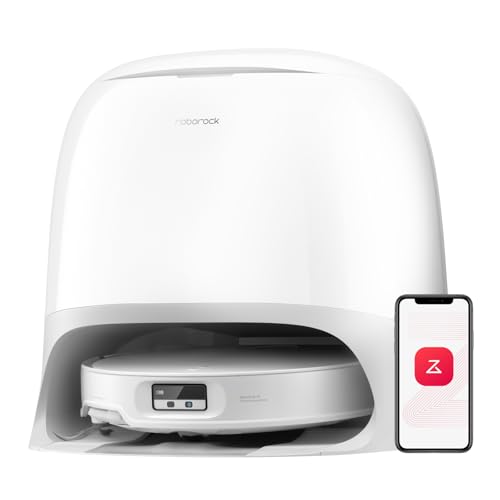
Most robots fail at the same three places: a doorway sill, a cable on the floor, and a staircase. Navigation hardware decides which of those it survives.
Disclosure — some links on this page go to Amazon, and we earn a commission if you buy through them. It costs you nothing extra and it does not change what we recommend or in what order. The full disclosure.
Most robot vacuums stop at a threshold around 20mm. Where makers publish a figure at all, current models range from 20mm to a claimed 80mm. Dreame and Roborock publish theirs; iRobot and Shark publish nothing. If your sills are over 20mm you are shopping in a much smaller pool than the roundups suggest.
Navigation is the part of a robot vacuum that decides whether it cleans your house or a subset of it. Suction determines how well it cleans the floor it reaches. Navigation determines which floors those are.
Three separate systems are usually collapsed into the word: how the robot builds a map, how it avoids things in real time, and how it physically gets over what is in the way. They fail independently. A robot with an excellent map can still be defeated by a 30mm door sill.
The threshold problem, which nobody tabulates
This is the single clearest gap in the published information about robot vacuums. Manufacturers publish climb heights inconsistently, describe them in different units, attach different conditions, and in several cases do not publish them at all — while still marketing chassis-lift hardware whose only purpose is climbing.
Published maximum threshold climb height, every model we cover
11 of 29 models publish this figure. Every number below links to the page it came from.
60mm over a series of steps, 42mm over a single step
Dreame's own condition, quoted: "The gap between steps should be greater than 4cm. For a single obstacle crossing and a single vertical step, the highest obstacle crossing height is 4.2cm." The 6cm headline therefore does not describe a single door sill.Source: Dreame X50 Ultra product page — ProLeap step climbing (retrieved 2026-09-01)
Not stated on eufy's E28 page. A figure of 0.83in appears in a bundle comparison table elsewhere on eufy's site; because it is not on the product page for this variant we do not publish it.
Compiled from the manufacturers’ own published material — every row carries the date its figure was read. We have not measured any of these figures ourselves, see how we pick. Found an error? Tell us and we will correct it.
Read the conditions column carefully, because that is where the headline numbers come apart. Dreame's X50 Ultra is advertised as clearing 60mm, and Dreame's own footnote states that this applies to a series of steps with more than 40mm between them, while a single vertical step is 42mm. Roborock's 40mm on the Qrevo CurvX is a double-layer threshold with the chassis lift engaged, and Roborock publishes no separate figure for a single vertical sill. ECOVACS states 20mm and specifies that this is with the mop attached, which is genuinely useful and almost unique.
Every one of those figures also assumes a clean square edge. A worn, rounded or carpet-edged sill behaves differently and generally worse. We have not measured any of this — nobody here owns one of these machines — but we have read every published figure and put them in one place, which is more than the field currently offers. The full page, with the arithmetic in both units, is the robot vacuum threshold climb table.
How the map gets built
There are three approaches in current use, and the differences show up in specific, predictable ways.
LiDAR — a spinning laser turret measures distance in a 360-degree sweep. Accurate, fast, and works in complete darkness because it supplies its own light. The turret adds height to the robot, which is why LiDAR models have historically struggled to get under low furniture. Roborock's PreciSense and Shark's 360-degree LiDAR are both this.
vSLAM — a camera builds the map from visual features in the room. No turret, so a lower body, but it needs light. In a dark room a vSLAM robot is navigating from memory. iRobot's PrecisionVision is camera-based.
Solid-state and hybrid sensing — dToF sensors and structured light with no moving turret. Roborock's StarSight on the Saros 10R and ECOVACS' dToF with AIVI 3D are both here, and both allow a much lower body: 80mm on the Saros, against the 130mm of clearance eufy states the X10 Pro Omni needs.
Navigation system, as each maker names it
28 of 29 models publish this figure. Every number below links to the page it came from.
Compiled from the manufacturers’ own published material — every row carries the date its figure was read. We have not measured any of these figures ourselves, see how we pick. Found an error? Tell us and we will correct it.
The trade-offs, and which failure mode each buys you, are set out on LiDAR versus vSLAM. If cameras in the house are a concern for you rather than a feature, that is worth reading alongside what robot vacuums actually collect.
Obstacle avoidance is a separate system
Mapping tells the robot where the walls are. Obstacle avoidance is what stops it eating a charging cable, and it runs on different hardware — usually a forward-facing camera, a structured-light projector, or both. Roborock states its Reactive AI recognizes 108 object types on the Curv line. iRobot markets its avoidance specifically against pet waste, which is the failure with the highest cost of any in this category.
It is not perfect on any model and the honest advice is to pick up cables anyway. Detail on obstacle avoidance, and — for the obstacle where a miss is expensive rather than annoying — robot vacuums and pet accidents.
Quick picks
Ranked on the published specifications below. Tap a row to jump to the full write-up.
#
Product
Best for
Max climb
Price
1
Dreame X50 UltraThe only model here that legs itself over a step rather than driving at it, and the only one that publishes the condition attached to its own headline number.
The tallest published climb figure
60mm over a series of steps, 42mm over a single step
Roborock Qrevo CurvXThe highest published suction figure here paired with the highest published mop lift, which is the combination a mixed-floor home actually needs.
Dreame L40s UltraStates 40mm of obstacle clearing and a fully detangling brush, which covers the two problems that actually send robots back to the shop.
iRobot Roomba j9+The vacuum-only j9+ is the model whose obstacle avoidance is specifically marketed against pet waste, which is a failure mode with a very high cost.
Roborock Q7 M5Proper 360-degree LiDAR mapping and an anti-tangle main brush at a price where a lot of robots still bounce off the walls.
Real LiDAR mapping at the low end
Not published
Every figure in this table is linked to the page it came from in the write-ups below. We have not tested any of these machines.
Top pick
Dreame X50 Ultra
The tallest published climb figure
The only model here that legs itself over a step rather than driving at it, and the only one that publishes the condition attached to its own headline number.
60mm over a series of steps, 42mm over a single stepDreame's own condition, quoted: "The gap between steps should be greater than 4cm. For a single obstacle crossing and a single vertical step, the highest obstacle crossing height is 4.2cm." The 6cm headline therefore does not describe a single door sill.Source: Dreame X50 Ultra product page — ProLeap step climbing (retrieved 2026-09-01)
Publishes the caveat as well as the headline, which is rarer than it should be
20,000 Pa stated peak suction and a 395ml on-board bin
Stated 220 minutes of runtime in quiet mode
What it does not
The legs add height and mechanical complexity to a machine that lives under furniture
10.5mm mop raise is modest next to the 17mm figures from Roborock
Who it is for
Split-level rooms, a sunken living room, or a doorway sill that has beaten every robot you have owned.
Skip it if
You read the 6cm headline and stopped there. Dreame's own footnote puts a single vertical step at 42mm, and 6cm only applies to a series of steps with more than 4cm between them.
Shark names its navigation hardware clearly — 360-degree LiDAR plus a 3D sensor — and then markets "NeverStuck" as the answer to the exact problem this hub is about, without publishing a single height. If getting over a sill is the thing you are buying for, buy from a maker willing to state the number.
Skip this one
eufy 11S MAX
It has no map, which is the whole point of it and also why it does not belong on this hub. No map means no room selection, no no-go zones, no resume after charging and no way to keep it out of the one room with the cables in it. For a single room it is fine. For a layout problem it is the opposite of the answer.
Multi-floor homes and where to start
If you have more than one story the robot needs multi-level mapping, and it needs to recognize which floor it is on when you carry it up. Most mapped models here support several saved maps; the cheap ones do not. Robot vacuums for multiple floors covers what changes, and mapping tips covers getting a good first map — which is worth an hour of your attention, because a bad first map produces a year of odd behavior.
Floor area changes which specifications bind, and it changes them in both directions. In a small apartment the dock footprint and the body height decide the buy while runtime never matters; in a large house runtime, bin capacity and recharge-and-resume are the only things that matter and the rest is noise. Both are worth reading before you shop on a spec sheet written for an average home.
There is a second physical constraint alongside the threshold, and it stops a robot getting under things rather than into rooms. Published body heights run from about 80mm to 100mm, and the difference is almost entirely the LiDAR turret. Robot vacuums that fit under furniture has the cross-brand height table and the five-minute method for measuring your own lowest gap.
Go deeper on navigation
The threshold climb table is the page most people need. It is the only cross-brand comparison of published climb heights we could find anywhere.
Most current models clear about 20mm, and where makers publish a figure the range runs from 20mm to a claimed 80mm under specific conditions. Measure your tallest sill before you buy: it is the cheapest thing you can do and it rules out most of the market in some houses.
+ What is the maximum threshold height for a robot vacuum?
There is no single answer, which is the point of our table. Dreame states 42mm for a single vertical step on the X50 Ultra and 60mm for a series of steps with gaps over 40mm. Roborock states 40mm for a double-layer threshold on the Qrevo CurvX. Several makers publish nothing at all.
+ Robot vacuum LiDAR vs vSLAM: which is better?
LiDAR maps more accurately and works in the dark; vSLAM allows a lower body and adds no turret. If your house has dim rooms, LiDAR. If your problem is furniture clearance, look at the solid-state models instead of either. Full comparison on LiDAR versus vSLAM.
+ Do robot vacuums fall down stairs?
Not normally — infrared cliff sensors detect the drop and stop the robot. The exception is a dark or very glossy floor that absorbs the infrared, which can confuse the sensor in either direction. Keep the sensors clean; a dusty cliff sensor is the usual cause of odd stair behavior.
+ Do I need mapping, or is a bump-and-turn robot enough?
For a single room, bump-and-turn is enough and much cheaper. For a whole floor it is not: without a map there is no room selection, no no-go zones and no reliable coverage, so you get visibly missed patches on every run.
+ Why does my robot vacuum keep getting stuck in the same place?
Almost always a physical trap the map cannot represent — a sill it can nearly climb, a rug edge that lifts, a chair base that catches the bumper. The fix is a no-go zone rather than a setting. See why it keeps getting stuck.