Disclosure — some links on this page go to Amazon, and we earn a commission if you buy through them. It costs you nothing extra and it does not change what we recommend or in what order. The full disclosure.
Glazed ceramic and porcelain tile tolerate more water than any other floor in the house, so this is the surface where a roller mop or a high water setting earns its keep. The two constraints are grout, which is porous unless sealed, and textured tile, which holds debris a flat pad skims over.
Tile rooms — kitchens, bathrooms, entryways — are also the dirtiest rooms in most houses. They collect grease, tracked-in grit and, in a cat household, litter. That combination is why the mop specification matters more here than anywhere else.
Water: the one floor where you can turn it up
Glazed tile is impervious. The tile itself will not swell, stain or lift however wet it gets. That changes the calculus completely from laminate, where the whole discussion is about keeping water out of the seams.
The exception is grout. Cement grout is porous unless it has been sealed, and porous grout absorbs water along with whatever is in it — which over time is what turns light grout dark. Sealed grout is fine. Unsealed grout in a kitchen will discolor with repeated wet mopping regardless of what is doing the mopping.
Unglazed and natural stone tile — slate, travertine, unsealed terracotta — behave like unsealed grout across the whole surface. Vacuum freely; check the sealing before you mop. Same rule as which floors can you mop.
Texture is the underrated problem
A riven slate, a structured porcelain or an anti-slip bathroom tile has a deliberately uneven surface. A flat mop pad rides across the high points and never reaches the low ones, so the floor looks mopped and the texture stays dirty. Grit sits in the same places.
On textured tile the brush does more useful work than the mop, and a roller mop with a scraper reaches further into the surface than a flat spinning pad. That is the main reason the X9 PRO OMNI leads the picks here rather than on the laminate page, where the same hardware is a liability.
How we picked
Criteria first, products second. These are the things we ranked on, stated before anything is recommended.
Mop mechanism, favoring designs that keep the water clean across a large floor.
Whether the dock washes the pad in hot water, since tile floors collect greasy kitchen soil.
Brush type, because textured tile holds debris a pad cannot reach.
Edge handling, because tile rooms are usually the ones with kickboards and appliance gaps.
Published specifications generally — a maker that states its figures ranks above one that does not.
What we did not do: test any of these machines. We do not own one, we do not have a lab, and nothing on this page is written as though we did. The full method.
Quick picks
Ranked on the published specifications below. Tap a row to jump to the full write-up.
#
Product
Best for
Mop lift
Price
1
ECOVACS DEEBOT X9 PRO OMNIThe roller mop that washes itself continuously while it runs rather than pushing one increasingly dirty pad around, now with a cyclone-directed anti-tangle brush.
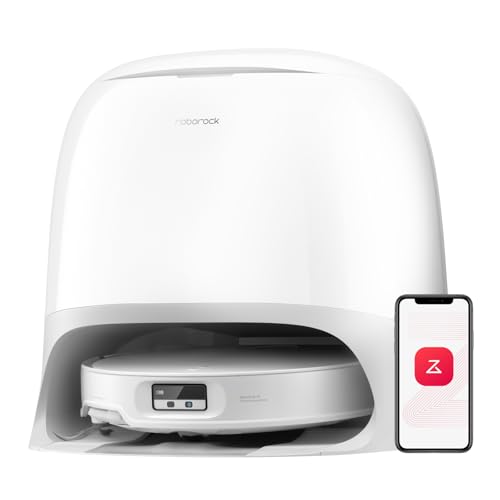
Roborock Qrevo CurvXThe highest published suction figure here paired with the highest published mop lift, which is the combination a mixed-floor home actually needs.
Dreame L40s UltraStates 40mm of obstacle clearing and a fully detangling brush, which covers the two problems that actually send robots back to the shop.
Every figure in this table is linked to the page it came from in the write-ups below. We have not tested any of these machines.
Top pick
ECOVACS DEEBOT X9 PRO OMNI
Mopping that rinses as it goes
The roller mop that washes itself continuously while it runs rather than pushing one increasingly dirty pad around, now with a cyclone-directed anti-tangle brush.
Self-emptying into a 3L bag, with temperature-controlled mop washing stated from 40C to 75C (104F to 167F) and hot-air dryingECOVACS publishes a wash temperature RANGE rather than a single figure, and states selectable drying durations of 2, 3 or 4 hours.Source: ECOVACS DEEBOT X9 PRO OMNI product page — station (retrieved 2026-10-03)
What it does well
OZMO Roller self-washes during the run rather than only at the dock
Publishes a threshold figure and states the condition (with mop attached)
Mop washing is temperature-controlled across a stated 40C to 75C range rather than a single number
What it does not
20mm climb is among the lowest published figures here
0.22L on-board bin is small, so it leans hard on the dock
16,600 Pa is lower than the model it replaces, which stated 18,000 Pa
Who it is for
Hard floors that actually get dirty — kitchens, entryways, homes with dogs.
Skip it if
Your sills are tall. ECOVACS publishes 20mm with the mop attached, which is at the low end of our threshold table.
It does not mop, and on tile the mopping is most of the job — a tiled kitchen that is vacuumed but never washed still looks dirty. It is also a bump-and-turn robot, and open tiled areas are exactly where a random cleaning pattern leaves visible misses.
Yes, and tile is the most forgiving surface for it. Glazed ceramic and porcelain are impervious. The caveats are unsealed grout, which absorbs water and darkens over time, and natural stone that has not been sealed.
+ Do robot vacuums clean grout lines?
They clean along them rather than into them. A rotating roller mop reaches further into a recessed grout line than a flat spinning pad, but no robot replaces a brush and a grout cleaner for a deep clean.
+ Do robot vacuums work on textured or slate tile?
Vacuuming works well. Mopping is limited, because a pad rides on the high points of the texture and never reaches the low ones. On textured tile, prioritize the brush over the mop.
+ What is the best robot vacuum for tile floors and carpet?
One with a published mop lift greater than your carpet pile, or one whose pad retracts entirely. Tile wants water and carpet does not, so the transition behavior is the whole decision. See mop lift height compared.