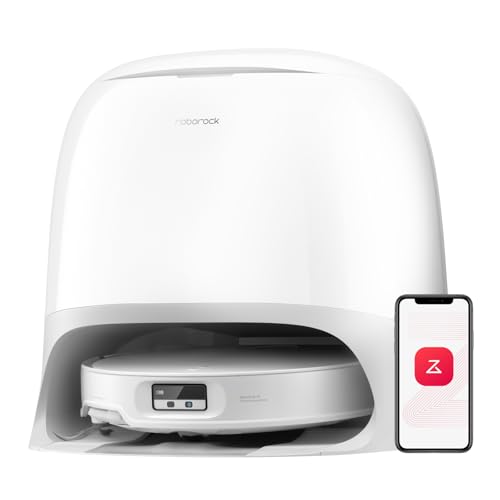
Sand is heavy, abrasive and relentless, and it is the one thing on a floor that a side brush cannot flick anywhere useful. It also eats brush bearings, which changes what you should buy.
Disclosure — some links on this page go to Amazon, and we earn a commission if you buy through them. It costs you nothing extra and it does not change what we recommend or in what order. The full disclosure.
Buy the iRobot Roomba Max 715 Pet: it states 30,000 Pa, uses dual rubber anti-tangle brushes, and its sealed AllergenLock dock is stated at 90 days with a published 0.7-micron filtration figure. And whatever you buy, vacuum before you mop, never the other way round - a mop pad dragged over sand is a sanding block.
Sand behaves differently from everything else a robot vacuum deals with, and the difference is weight. Household dust is light enough that a side brush flicks it toward the intake and airflow does the rest. Sand grains are dense: they roll rather than fly, they sit in the bottom of a carpet pile rather than on top of it, and they are heavy enough that a weak airflow genuinely fails to lift them. This is the one debris type where a published pascal figure earns its place in a decision.
The second difference is that sand is abrasive, and the thing it abrades is your floor and your robot. Both of those have consequences for what you should buy.
The mopping order, which matters more than the machine
Never let a mop pad go over sand before the vacuum has. A damp pad does not lift grains; it traps them against the floor and drags them. On tile that dulls the glaze and loads the grout. On sealed hardwood or vinyl plank it puts fine scratches in the finish, which is the one kind of damage you cannot undo. Scratched floors and scuffed baseboards covers the wider version of this.
A mop-combo robot that vacuums and mops in the same pass is therefore the wrong default on a sandy floor. If you want mopping, run a vacuum-only pass first and the mop pass afterwards, or accept that a machine doing both at once is dragging grit. A roller mop that rinses continuously is better than a single pad here, because the pad is not carrying the same grit for the whole run - spinning pads vs roller mops is the mechanism comparison.
Suction: the one page where the number does work
Highest published suction figures on this site
5 of 5 models publish this figure. Every number below links to the page it came from.
Compiled from the manufacturers’ own published material — every row carries the date its figure was read. We have not measured any of these figures ourselves, see how we pick. Found an error? Tell us and we will correct it.
Two cautions before you shop off that ledger. First, these figures are not measured the same way - each maker uses its own rig, and the argument against reading them across brands is set out on the suction chart. Second, the top of the published range is 31,000 Pa and the bottom is 5,300, and the top is not six times better at picking up sand. What the figures reliably tell you is which machines their makers positioned as the powerful ones, and on sand that is a better guide than it is on dust.
Note that the Narwal Flow 2 holds the highest published figure on this site at 31,000 Pa and publishes five of the nine rows - no climb height, no dustbin capacity and no body height. The Roomba Max 715 Pet states 30,000 Pa, which is within rounding of it, and backs it with the sealed dock and the published brush construction that the Narwal does not match.
The brush is the part sand destroys
Main brush construction on the machines considered here
4 of 5 models publish this figure. Every number below links to the page it came from.
Brush construction is not described on the listing.
Compiled from the manufacturers’ own published material — every row carries the date its figure was read. We have not measured any of these figures ourselves, see how we pick. Found an error? Tell us and we will correct it.
Grit works into the end-cap bearings at each end of the main brush, and on a floor with sand on it that is a steady, daily process rather than an occasional one. Nobody publishes a bearing life and we will not estimate one. What you can insist on is that the maker describes the brush at all, because it is the part you will be buying again - and because a brush you can pull out and rinse under a tap is a different proposition from a dense bristle row that holds grains in it.
If there is a dog in the house as well, you are dealing with sand and hair in the same brush, which is the combination that jams it. A rubber anti-tangle construction handles both better than bristles handle either - rubber vs bristle brushes is the cross-brand comparison, and robot vacuums for pet hair is the wider field.
Where the sand ends up
Fine sand loads a filter much faster than carpet fluff, and it is heavy, so a small on-board bin fills visibly quickly. On-board bin capacity is published for four of the 29 machines on sale here, which means for most of them you will discover the answer in week one. The practical consequences:
A self-emptying dock stops being a luxury. Without one you will be emptying the robot's bin most runs, not every few runs. The published intervals and the bag-versus-bagless argument are on self-emptying dock or manual bin.
Prefer a bag to a bagless base. Tipping a cup of fine sand into a trash can puts it straight back into the air in the room you just cleaned.
Check the filter on behavior, not on a date. If it still looks loaded after you tap it out, replace it. Replacement parts and what they cost has the honest signal for each part.
Expect to clean the wheels and the caster. Grains pack into a caster housing and that is a common cause of a robot that starts driving in circles - why the robot goes in circles.
Keep most of it out in the first place
This is not a product recommendation and it is the highest-value thing on this page. A coarse mat outside the door and a second one inside removes a large share of tracked-in sand before it reaches the floor, and a robot vacuum run daily handles what gets past them easily. A machine bought instead of the mats will be fighting the problem forever; a machine bought alongside them is doing a job it is good at.
How we picked
Criteria first, products second. These are the things we ranked on, stated before anything is recommended.
This is the one page where a published suction figure gets real weight. Sand grains are heavy relative to household dust, so the figure correlates with something physical here in a way it does not on a hard floor covered in fluff.
Require a published brush construction. Grit wears brush bearings, so the brush is the component you will replace, and a machine that does not describe it is a machine you cannot judge.
Credit sealed filtration and a long dock interval. Fine sand loads a filter quickly and you will be opening the dock more often than the stated interval implies.
Credit a published mop lift for any house with rugs, because a wet pad dragged over sandy carpet is the worst version of this problem.
No testing claims. No maker publishes a sand-pickup figure and we have not measured one. These criteria are physical reasoning from sourced specifications - see how we pick.
What we did not do: test any of these machines. We do not own one, we do not have a lab, and nothing on this page is written as though we did. The full method.
Quick picks
Ranked on the published specifications below. Tap a row to jump to the full write-up.
#
Product
Best for
Mop lift
Price
1
iRobot Roomba Max 715 PetDual rubber anti-tangle brushes and a 90-day allergen-sealed dock — and the one place iRobot has printed an actual suction number instead of a multiple.
Narwal Flow 2The roller-mop machine that publishes the most: suction, mop lift, wash temperature, drying temperature, dock interval, battery and a noise figure, all on one page.
Roborock Qrevo CurvXThe highest published suction figure here paired with the highest published mop lift, which is the combination a mixed-floor home actually needs.
eufy Omni S2eufy's flagship, and the only machine here that publishes a mop lift in inches rather than millimeters — a stated 1.1in, roughly double the next-highest figure we have recorded.
Every figure in this table is linked to the page it came from in the write-ups below. We have not tested any of these machines.
Top pick
iRobot Roomba Max 715 Pet
The only Roomba with a stated Pa figure
Dual rubber anti-tangle brushes and a 90-day allergen-sealed dock — and the one place iRobot has printed an actual suction number instead of a multiple.
The roller-mop machine that publishes the most: suction, mop lift, wash temperature, drying temperature, dock interval, battery and a noise figure, all on one page.
Not publishedNarwal publishes a 7,000mAh battery capacity but no runtime in minutes. Capacity without a draw figure does not give you a run time.
Dock
Auto self-emptying into a 2.5L bag, stated up to 120 days, with mop washing at 113-176F and warm-air drying at 104FThe 120-day figure is the longest stated self-empty interval of any machine on this site. Narwal also states the base station washes at up to 212F.Source: Narwal Flow 2 product page — base station (retrieved 2026-09-26)
What it does well
Publishes more rows than any other roller mop here, including a noise figure most makers omit
12mm mop lift is published, so the carpet question has an actual number behind it
Dock bag stated at 2.5L and up to 120 days, the longest stated interval of any machine on this site
What it does not
The most expensive roller mop we cover by a clear margin
No published climb height, so thresholds are an unknown
No published body height or runtime, despite publishing a battery capacity
Who it is for
Someone buying the mechanism rather than the badge, who wants the specification available before spending flagship money.
Skip it if
Your budget is the constraint. This is the most expensive roller mop we cover, and the eufy C28 brings the same idea in for a lot less.
eufy's flagship, and the only machine here that publishes a mop lift in inches rather than millimeters — a stated 1.1in, roughly double the next-highest figure we have recorded.
35mm single step, 42mm double stepeufy publishes both conditions (1.38in and 1.65in on the US page). The 35mm single-step figure is the second-highest SINGLE-step figure on this site, behind only the Dreame X50 Ultra's 42mm.Source: eufy Omni S2 US product page — climb height (retrieved 2026-10-17)
Mop lift
1.1in (roughly 28mm)The highest mop lift figure on this site; the next highest published anywhere here is the 17mm Roborock states for the Qrevo CurvX and the Saros 10R. eufy states the chassis also raises for carpet up to 2in thick, but its regional pages disagree on that limit so it is not relied on.Source: eufy Omni S2 US product page — mop lift (retrieved 2026-10-17)
Not publishedNot stated on the US page for this model, which is unusual at this price.
Dustbin
Not publishedNot stated on the US page.
Body height
Not publishedNot stated on the US page, so whether it fits under low furniture cannot be checked before purchase.
Dock
12-in-1 UniClean station: mop washing with electrolyzed water at a stated 60C, hot-air drying at a stated 55C, automatic detergent dispensing, self-emptying and waste-water collectioneufy publishes both temperatures as single figures rather than a range, which makes them checkable against the 40C to 75C range ECOVACS states.Source: eufy Omni S2 US product page — UniClean station (retrieved 2026-10-17)
What it does well
A stated 1.1in mop lift, the highest figure published by any maker on this site
Publishes both climb figures with conditions attached — 35mm over a single step and 42mm over a double
Station washes at a stated 60C and dries at 55C, both published rather than described as hot
What it does not
No published runtime, dustbin capacity or robot height
The most expensive eufy by a wide margin, and the price buys station features rather than a better clean
eufy's regional pages disagree on the mop's rotation speed and the carpet-height limit, so neither is quoted here
Who it is for
A home with both deep carpet and hard floors that get genuinely dirty, where a wet pad dragged onto a rug is the failure you are paying to avoid.
Skip it if
You want a published runtime, bin capacity or body height. eufy states none of the three for this model, so you cannot tell how long it runs or whether it fits under your furniture.
The cheapest way into Roborock's Qrevo line and the wrong machine for this particular job, for two published reasons rather than one. Its stated 7,000 Pa is the lowest figure in Roborock's current range, and sand is the single debris type where a low suction figure is genuinely felt - grains are heavy, they roll away from a side brush, and they sit in the bottom of a carpet pile. More telling, Roborock does not describe its main brush at all for this model. On a floor where abrasive grit is going through the brush every day, buying a machine whose brush construction is not published is buying the one component most likely to wear without knowing what it is.
Which one for which house
A beach house with hard floors and a dog - the Roomba Max 715 Pet. A stated 30,000 Pa, dual rubber anti-tangle brushes plus an anti-tangle side brush, and a sealed 90-day dock with a published 0.7-micron figure. Vacuum-only, which is the right default on sand.
You want the biggest published suction figure there is - the Narwal Flow 2 at a stated 31,000 Pa, with a 12mm mop lift. Accept that it publishes no climb height, no bin capacity and no body height.
Sand on hard floors plus rugs you need kept dry - the Roborock Qrevo CurvX, for a published 17mm mop lift and 22,000 Pa in an 80mm body.
Sand and deep carpet in the same house - the eufy Omni S2, whose stated 1.1in mop lift is the highest published figure on this site by a wide margin, alongside 30,000 Pa.
It is really a tile floor with sand on it - robot vacuums for tile floors has the grout and the wet-cleaning detail this page does not.
It is a concrete slab with sand tracked over it - robot vacuums for concrete floors, where whether the slab is sealed changes the whole answer.
Questions people actually ask
+ What is the best robot vacuum for sand?
The iRobot Roomba Max 715 Pet, on published figures: a stated 30,000 Pa, dual rubber anti-tangle main brushes with an anti-tangle side brush, and a sealed AllergenLock dock stated at 90 days with a published 0.7-micron filtration rating. The Narwal Flow 2 states a slightly higher 31,000 Pa but publishes no brush durability detail, no bin capacity and no climb height.
+ Can a robot vacuum pick up sand?
Yes, from hard floors, and this is one of the jobs they are genuinely good at if you run them daily. Sand on carpet is harder, because grains sink to the base of the pile below where airflow reaches. Expect a robot to keep hard floors clear and to keep a rug's surface clear, and expect to deep-clean the rug occasionally with an upright.
+ Will sand damage a robot vacuum?
It wears it faster than household dust does. Grit works into the bearings at each end of the main brush, packs into the caster wheel housing, and loads filters quickly. No maker publishes a bearing life, so this cannot be ranked - but it is a reason to buy a machine whose brush construction is published and whose brush can be pulled out and rinsed.
+ Should a robot vacuum mop a sandy floor?
Not until it has vacuumed it. A damp pad dragged over sand traps grains against the floor and acts like a sanding block - it dulls tile glaze and puts fine scratches in sealed hardwood or vinyl. If you want mopping, run a vacuum pass first, and prefer a roller mop that rinses continuously over a single pad that carries the same grit for the whole run.
+ Is a self-emptying dock worth it for sand?
More than for any other debris. Sand is dense, so a small on-board bin fills in a run or two rather than over a week - and on-board bin capacity is published for only four of the 29 models currently on sale here. Choose a bagged dock over a bagless one: tipping out a cup of fine sand puts it straight back into the air.
+ How do I stop sand getting onto the floor in the first place?
A coarse mat outside the door and a second one inside, which is unglamorous and more effective than any machine on this page. A robot run daily handles what gets past them without difficulty. Buying a robot instead of the mats leaves it fighting the problem permanently.