Disclosure — some links on this page go to Amazon, and we earn a commission if you buy through them. It costs you nothing extra and it does not change what we recommend or in what order. The full disclosure.
Published suction on current robot vacuums runs from 5,300 Pa to 22,000 Pa. Every figure is a peak measured by the manufacturer, with its own method, at the nozzle with nothing in the way. It ranks models reliably inside one brand's range. Across brands it is a tier indicator and not a comparison.
The pascal number is the most quoted specification in this category and the least standardized. There is no industry test for it, no shared apparatus, and no requirement to state the conditions. Two makers can both be telling the truth and produce numbers that are three times apart for machines that clean similarly.
The table
Stated peak suction, every model we cover
27 of 29 models publish this figure. Every number below links to the page it came from.
Compiled from the manufacturers’ own published material — every row carries the date its figure was read. We have not measured any of these figures ourselves, see how we pick. Found an error? Tell us and we will correct it.
Three things stand out. First, the spread inside a single brand is enormous — Roborock alone publishes figures from 7,000 Pa to 22,000 Pa, and those machines are much closer in real use than a threefold ratio suggests. Second, iRobot publishes no absolute figure at all, quoting only that the Combo j9+ has 100 percent stronger suction than an older iRobot model. Third, Shark publishes nothing for either model we cover.
We are not going to estimate a figure for the models that do not publish one. A number invented to complete a table is worse than a blank, because a blank is honest about what is known.
What a pascal figure is actually measuring
Pascals measure pressure — specifically the vacuum pressure the fan can generate. That is not the same as the thing that lifts debris off a floor, which is airflow at the nozzle. High pressure with poor airflow moves less material than moderate pressure with good airflow, which is why a headline pascal figure can rise generation over generation without the machine cleaning noticeably better.
The full glossary treatment, along with the other specs that are quoted without conditions, is on the spec glossary.
What to use instead when comparing brands
Carpet detection and boost behavior — whether the robot notices the transition, and how much headroom it has left when it does. Covered on carpet boost.
Brush contact with the pile. A brush riding above deep pile is not cleaning it, whatever the fan is doing. See high-pile carpet.
Whether the robot can reach the carpet at all — a thick rug edge is a threshold. The climb table.
Bin capacity and dock interval, because a strong fan filling a small bin still stops mid-room.
Quick picks
Ranked on the published specifications below. Tap a row to jump to the full write-up.
#
Product
Best for
Suction
Price
1
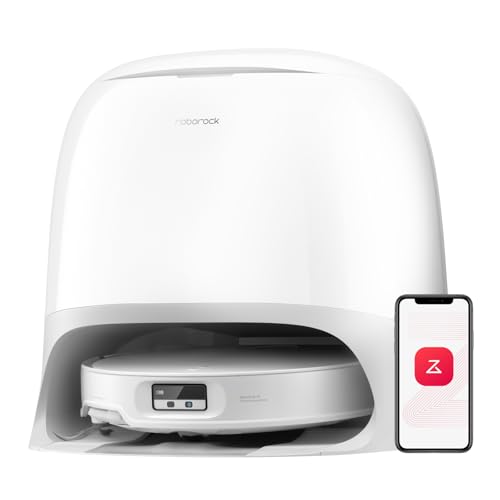
Roborock Qrevo CurvXThe highest published suction figure here paired with the highest published mop lift, which is the combination a mixed-floor home actually needs.
Dreame X50 UltraThe only model here that legs itself over a step rather than driving at it, and the only one that publishes the condition attached to its own headline number.
ECOVACS DEEBOT X9 PRO OMNIThe roller mop that washes itself continuously while it runs rather than pushing one increasingly dirty pad around, now with a cyclone-directed anti-tangle brush.
The only model here that legs itself over a step rather than driving at it, and the only one that publishes the condition attached to its own headline number.
60mm over a series of steps, 42mm over a single stepDreame's own condition, quoted: "The gap between steps should be greater than 4cm. For a single obstacle crossing and a single vertical step, the highest obstacle crossing height is 4.2cm." The 6cm headline therefore does not describe a single door sill.Source: Dreame X50 Ultra product page — ProLeap step climbing (retrieved 2026-09-01)
Publishes the caveat as well as the headline, which is rarer than it should be
20,000 Pa stated peak suction and a 395ml on-board bin
Stated 220 minutes of runtime in quiet mode
What it does not
The legs add height and mechanical complexity to a machine that lives under furniture
10.5mm mop raise is modest next to the 17mm figures from Roborock
Who it is for
Split-level rooms, a sunken living room, or a doorway sill that has beaten every robot you have owned.
Skip it if
You read the 6cm headline and stopped there. Dreame's own footnote puts a single vertical step at 42mm, and 6cm only applies to a series of steps with more than 4cm between them.
The roller mop that washes itself continuously while it runs rather than pushing one increasingly dirty pad around, now with a cyclone-directed anti-tangle brush.
Self-emptying into a 3L bag, with temperature-controlled mop washing stated from 40C to 75C (104F to 167F) and hot-air dryingECOVACS publishes a wash temperature RANGE rather than a single figure, and states selectable drying durations of 2, 3 or 4 hours.Source: ECOVACS DEEBOT X9 PRO OMNI product page — station (retrieved 2026-10-03)
What it does well
OZMO Roller self-washes during the run rather than only at the dock
Publishes a threshold figure and states the condition (with mop attached)
Mop washing is temperature-controlled across a stated 40C to 75C range rather than a single number
What it does not
20mm climb is among the lowest published figures here
0.22L on-board bin is small, so it leans hard on the dock
16,600 Pa is lower than the model it replaces, which stated 18,000 Pa
Who it is for
Hard floors that actually get dirty — kitchens, entryways, homes with dogs.
Skip it if
Your sills are tall. ECOVACS publishes 20mm with the mop attached, which is at the low end of our threshold table.
The three picks above are the highest published figures in this comparison, and they are recommended on that basis rather than on any claim about relative performance — which we have not measured and will not imply. Read them as the top of each maker's own range, not as a ranking against each other. Carpet is where the figure does earn its keep, and best robot vacuums for carpet ranks on it. For the two brands that publish no figure at all, see Shark vs Roomba. One of those two set directly against the brand that publishes a figure for everything is Roborock vs Shark.
Questions people actually ask
+ How many pascals do I need for carpet?
There is no honest number, because the figure is not standardized between brands. Within one brand's range, more is better on carpet. Across brands, decide on carpet boost, brush contact and climb height instead.
+ Is 8,000 Pa enough?
For hard floors and medium pile, comfortably. For deep pile the limiting factor is usually brush contact rather than airflow, so a higher figure on a machine that rides above the pile will not help.
+ Why do suction figures keep going up every year?
Partly genuine engineering and partly a specification race. Because there is no shared test, a maker can revise the headline figure by changing how it measures. Treat large year-on-year jumps as marketing until something else on the machine has also changed.
+ Which robot vacuum has the highest suction?
Of the models we cover, Roborock publishes 22,000 Pa for the Qrevo CurvX and the Saros 10R, and Dreame publishes 20,000 Pa for the X50 Ultra. Those are the highest stated figures, which is a different claim from the strongest machine.