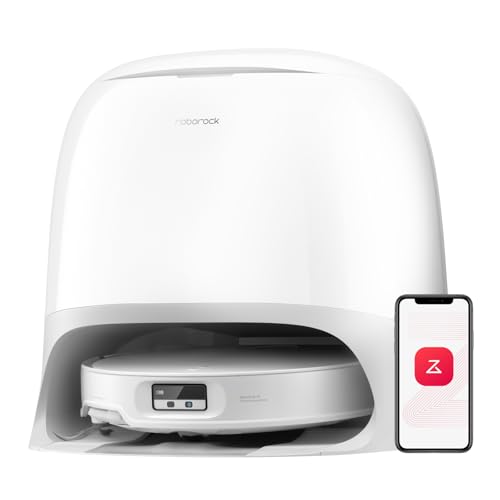
Above roughly 20mm of pile the robot starts floating on the fibers instead of pressing into them. No suction figure fixes a brush that is not touching anything.
Disclosure — some links on this page go to Amazon, and we earn a commission if you buy through them. It costs you nothing extra and it does not change what we recommend or in what order. The full disclosure.
Deep pile defeats robot vacuums physically rather than electrically. Above roughly 20mm the wheels sink, the body rides on the fibers and the brush loses contact with the base of the pile. The models that address it raise the chassis — Roborock's AdaptiLift and Dreame's ProLeap — rather than raising the suction figure.
There is a break point in this category that nobody advertises. Below it, most current robots handle carpet acceptably. Above it, performance falls off sharply and the reason has nothing to do with the specification everyone compares.
Why deep pile is a mechanical problem
Three failures stack up, and they compound.
The robot floats. Long fibers support the chassis, so the wheels compress the pile rather than reaching the backing. The whole machine sits higher than it was designed to.
The brush loses contact. A main brush set for a nominal ride height is now above the fibers it is meant to agitate. It spins in air over the deepest part of the pile.
Traction goes. Wheels on compressible fiber slip. The robot's odometry expects a certain distance per wheel rotation, gets less, and its position estimate drifts — which is why deep pile also produces mapping errors.
None of that is fixed by airflow. A 22,000 Pa fan connected to a brush that is not touching the carpet cleans exactly as well as an 8,000 Pa one in the same position.
What chassis lift actually changes
Roborock's AdaptiLift and Dreame's ProLeap are marketed as threshold hardware, and that is their headline use. On deep pile they do something else: raising the body changes the geometry between the brush and the surface, and on the models that lift sections independently it also keeps the machine level when one side is on carpet and the other is not.
Published climb height — the same hardware that helps on deep pile
6 of 6 models publish this figure. Every number below links to the page it came from.
60mm over a series of steps, 42mm over a single step
Dreame's own condition, quoted: "The gap between steps should be greater than 4cm. For a single obstacle crossing and a single vertical step, the highest obstacle crossing height is 4.2cm." The 6cm headline therefore does not describe a single door sill.Source: Dreame X50 Ultra product page — ProLeap step climbing (retrieved 2026-09-01)
Compiled from the manufacturers’ own published material — every row carries the date its figure was read. We have not measured any of these figures ourselves, see how we pick. Found an error? Tell us and we will correct it.
Note that the climb figure and the deep-pile benefit are related but not the same thing, and no manufacturer publishes a specification for the second one. What we can tell you is which models have the hardware and what each maker states about it. What we cannot tell you is how each performs on your specific rug, because we have not run any of them on it.
How we picked
Criteria first, products second. These are the things we ranked on, stated before anything is recommended.
Whether the chassis can lift, which changes how the brush meets deep pile rather than just clearing a doorway.
Published climb height, because a thick rug edge is a threshold before it is a carpet.
Published suction, used as a within-brand ranking only — it is not comparable across makers.
Wheel design and traction, to the extent the maker describes it.
Mop behavior, because a wet pad on deep pile is a worse outcome than a dusty rug.
What we did not do: test any of these machines. We do not own one, we do not have a lab, and nothing on this page is written as though we did. The full method.
Quick picks
Ranked on the published specifications below. Tap a row to jump to the full write-up.
#
Product
Best for
Suction
Price
1
Dreame X50 UltraThe only model here that legs itself over a step rather than driving at it, and the only one that publishes the condition attached to its own headline number.
Roborock Qrevo CurvXThe highest published suction figure here paired with the highest published mop lift, which is the combination a mixed-floor home actually needs.
Dreame L40s UltraStates 40mm of obstacle clearing and a fully detangling brush, which covers the two problems that actually send robots back to the shop.
Every figure in this table is linked to the page it came from in the write-ups below. We have not tested any of these machines.
Top pick
Dreame X50 Ultra
The tallest published climb figure
The only model here that legs itself over a step rather than driving at it, and the only one that publishes the condition attached to its own headline number.
60mm over a series of steps, 42mm over a single stepDreame's own condition, quoted: "The gap between steps should be greater than 4cm. For a single obstacle crossing and a single vertical step, the highest obstacle crossing height is 4.2cm." The 6cm headline therefore does not describe a single door sill.Source: Dreame X50 Ultra product page — ProLeap step climbing (retrieved 2026-09-01)
Publishes the caveat as well as the headline, which is rarer than it should be
20,000 Pa stated peak suction and a 395ml on-board bin
Stated 220 minutes of runtime in quiet mode
What it does not
The legs add height and mechanical complexity to a machine that lives under furniture
10.5mm mop raise is modest next to the 17mm figures from Roborock
Who it is for
Split-level rooms, a sunken living room, or a doorway sill that has beaten every robot you have owned.
Skip it if
You read the 6cm headline and stopped there. Dreame's own footnote puts a single vertical step at 42mm, and 6cm only applies to a series of steps with more than 4cm between them.
Its thin body was the whole appeal and it is exactly wrong here. A low, light robot with no chassis lift rides on deep pile rather than pressing into it, loses wheel traction, and spends the run beaching itself on rug edges. It suited a hard-floor apartment and was the worst possible match for shag. It was withdrawn from sale on 2026-10-10, which settles the question for this page.
If your carpet is very deep
Be honest about the limit. A genuine shag with 30mm-plus fibers is beyond every robot vacuum currently sold, chassis lift or not. The realistic setup is a no-go zone over the shag and the robot handling everything else, with the deep rug done by hand or with an upright. That is a better outcome than a machine that beaches itself every afternoon.
+ What is the best robot vacuum for high pile carpet?
One that raises its chassis rather than one with the biggest suction figure. Ride height determines whether the brush is in the pile or above it, and no amount of airflow compensates for a brush that is not touching anything.
+ How deep is too deep for a robot vacuum?
Around 20mm of pile is where performance starts falling off on most models, and a genuine shag at 30mm-plus is beyond all of them. Above that the honest answer is a no-go zone and a different machine for that rug.
+ Do robot vacuums work well on carpet at all?
On low and medium pile, yes, and daily running is the advantage — it keeps ahead of debris in a way a weekly upright does not. Deep pile is the exception and it is a physical limit rather than a power one.
+ Will a robot vacuum get stuck on thick carpet?
It can, in two ways: beaching on the edge where the carpet meets a hard floor, and losing traction in the middle of deep pile. Both are more common than people expect and both are solved by a no-go zone if the model cannot manage the surface.