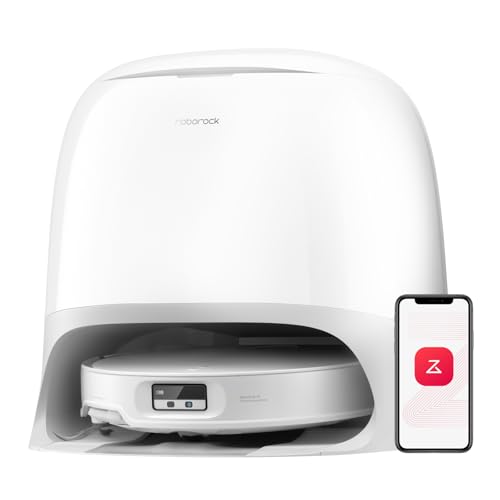
Concrete is the only floor in a house that manufactures its own dust. Whether yours is sealed decides whether you want a mop at all - and most buying guides never ask.
Disclosure — some links on this page go to Amazon, and we earn a commission if you buy through them. It costs you nothing extra and it does not change what we recommend or in what order. The full disclosure.
If your concrete is unsealed - a garage, a basement, a workshop - buy the iRobot Roomba Max 715 Pet and do not mop: it is vacuum-only, states 30,000 Pa, and its sealed AllergenLock dock is stated at 90 days with a published 0.7-micron filtration figure, which is the right answer to fine concrete dust. If your concrete is sealed or polished, buy the ECOVACS DEEBOT X9 PRO OMNI for its self-rinsing roller mop.
Concrete is unlike every other floor a robot vacuum meets, and the difference is not hardness. It is that concrete is a dust source rather than just a dust surface. Unsealed or lightly sealed slab sheds a fine gray powder continuously, from the slab itself, and keeps doing it for years. Add the grit that gets tracked into a garage or a basement and you have the single dustiest floor in most houses.
That changes which specifications matter. On hardwood the question is whether the robot scratches it; on carpet it is whether the suction reaches the base of the pile. On concrete the questions are where does all that dust end up and what is the grit doing to the machine.
First: is your concrete sealed?
This is the whole decision and it takes thirty seconds to answer. Put a few drops of water on the floor and wait a minute. If the water sits in a bead, it is sealed. If it soaks in and darkens the slab, it is unsealed.
What the seal decides
Unsealed concrete
Sealed or polished concrete
Should a robot mop it?
No
Yes
Why
Porous slab absorbs the water, the dust becomes a slurry, and dissolved salts can dry back out as a white bloom on the surface
The sealer keeps water on top, so a pad lifts dirt instead of pushing it into the floor
What to buy
A vacuum-only robot with the best filtration and the longest dock interval you can get
A mop combo, ideally one with a self-rinsing roller rather than a single pad
The machine risk
Abrasive grit in the brush bearings and a filter that clogs quickly
Grit dragged under a mop pad, which can scuff a polished finish
The polished-concrete case deserves one specific warning. A polished slab is a finish, and dragging a grit-loaded pad across it is exactly how you dull it. That is an argument for a roller mop that rinses itself continuously as it runs, rather than a pad that collects grit on pass one and carries it for the next twenty minutes. The mechanism comparison is spinning pads vs roller mops, and the field is on robot vacuums with a roller mop.
Where the dust goes, which is the real specification
Dock behavior and stated self-empty interval
5 of 5 models publish this figure. Every number below links to the page it came from.
All-in-One station: self-emptying into a stated 3.1L bag for up to 60 days in a pet-free home, mop washing, mop drying with room-temperature air, and water refilling from a 2.5L tank
Compiled from the manufacturers’ own published material — every row carries the date its figure was read. We have not measured any of these figures ourselves, see how we pick. Found an error? Tell us and we will correct it.
Two things in that ledger matter more on concrete than anywhere else. The first is whether the bag seals. On a dusty floor you will open the dock more often than the maker's stated interval suggests, and a bagless base means tipping a cup of extremely fine powder into a trash can. The Roomba Max 715's AllergenLock bag carries the only published filtration figure on this site - iRobot states 0.7 microns - and it is stated at 90 days, the longest interval here. On a concrete floor that combination is worth more than a suction number.
The second is on-board bin capacity, and almost nobody publishes it. Four of the 29 machines currently on sale here state one. The ECOVACS X9 PRO OMNI states 0.22L, which is small, and ECOVACS is candid that the machine leans on its dock as a result - on concrete, that means it will be docking to empty more often than it would on hardwood. The eufy Omni C20 states 250ml. For every other machine on this site, you will find out how big the bin is after you buy it.
If anyone in the house has a dust sensitivity, the filtration question stops being about convenience - robot vacuums, dander and allergies covers what a sealed bag and a stated micron rating actually buy you.
Grit is a durability problem, not a cleaning one
Main brush construction on the machines considered here
4 of 5 models publish this figure. Every number below links to the page it came from.
Brush construction is not described on the listing.
Compiled from the manufacturers’ own published material — every row carries the date its figure was read. We have not measured any of these figures ourselves, see how we pick. Found an error? Tell us and we will correct it.
Concrete grit is harder than the floor finish and much harder than a brush. It works into the same end-cap bearings that hair wraps around, and it is the reason a robot used mainly on a garage slab will wear its main brush faster than one on a rug. Nothing published lets us rank machines on bearing life, and we will not invent a ranking. What is published is the construction, and a rubber or finned brush that can be pulled out and rinsed is easier to keep clean of grit than a dense bristle row. The Roborock Qrevo Pro is the cautionary row here: Roborock does not describe its main brush at all, so you cannot tell what you are buying.
Expect to clean the filter far more often than the manual suggests, and judge it on behavior rather than a calendar - replacement parts and what they cost sets out the honest signals for each consumable.
The garage problem: a lip at the door
Published climb height on the machines considered here
4 of 5 models publish this figure. Every number below links to the page it came from.
Compiled from the manufacturers’ own published material — every row carries the date its figure was read. We have not measured any of these figures ourselves, see how we pick. Found an error? Tell us and we will correct it.
Most concrete in a house is in a garage, a basement or a utility room, and all three usually sit behind a step or a raised threshold that the rest of the house does not have. Measure it before anything else. iRobot publishes no climb height for any model, including the machine ranked first on this page - so if the robot has to get itself over a garage lip rather than being carried over it, that pick does not work and the published figures in the threshold table should drive the choice instead.
How we picked
Criteria first, products second. These are the things we ranked on, stated before anything is recommended.
Split on sealed versus unsealed first, because it changes the answer completely. Mopping unsealed concrete makes mud and can draw salts to the surface; mopping sealed concrete is fine and useful.
Weigh filtration and the dock interval heavily. Concrete generates fine dust constantly, so how well the dock seals it and how rarely you open it matter more here than on any other floor.
Treat brush construction as a durability question, not just a hair question. Grit on a hard floor is abrasive, and it goes into the same bearings that hair wraps around.
Credit a published climb height. Concrete is usually a garage, a basement or a converted space, and those have door lips that other floors do not.
No testing claims. We have not run any machine on a concrete floor. The criteria are reasoning from published figures; the figures themselves are sourced on each spec sheet.
What we did not do: test any of these machines. We do not own one, we do not have a lab, and nothing on this page is written as though we did. The full method.
Quick picks
Ranked on the published specifications below. Tap a row to jump to the full write-up.
#
Product
Best for
Mop lift
Price
1
iRobot Roomba Max 715 PetDual rubber anti-tangle brushes and a 90-day allergen-sealed dock — and the one place iRobot has printed an actual suction number instead of a multiple.
ECOVACS DEEBOT X9 PRO OMNIThe roller mop that washes itself continuously while it runs rather than pushing one increasingly dirty pad around, now with a cyclone-directed anti-tangle brush.
Roborock Qrevo CurvXThe highest published suction figure here paired with the highest published mop lift, which is the combination a mixed-floor home actually needs.
eufy Omni C20One of the two least powerful machines on this site on paper, and the one that tells you the most about itself for the money — suction, climb, mop lift, runtime, bin and body height are all published.
Every figure in this table is linked to the page it came from in the write-ups below. We have not tested any of these machines.
Top pick
iRobot Roomba Max 715 Pet
The only Roomba with a stated Pa figure
Dual rubber anti-tangle brushes and a 90-day allergen-sealed dock — and the one place iRobot has printed an actual suction number instead of a multiple.
The roller mop that washes itself continuously while it runs rather than pushing one increasingly dirty pad around, now with a cyclone-directed anti-tangle brush.
Self-emptying into a 3L bag, with temperature-controlled mop washing stated from 40C to 75C (104F to 167F) and hot-air dryingECOVACS publishes a wash temperature RANGE rather than a single figure, and states selectable drying durations of 2, 3 or 4 hours.Source: ECOVACS DEEBOT X9 PRO OMNI product page — station (retrieved 2026-10-03)
What it does well
OZMO Roller self-washes during the run rather than only at the dock
Publishes a threshold figure and states the condition (with mop attached)
Mop washing is temperature-controlled across a stated 40C to 75C range rather than a single number
What it does not
20mm climb is among the lowest published figures here
0.22L on-board bin is small, so it leans hard on the dock
16,600 Pa is lower than the model it replaces, which stated 18,000 Pa
Who it is for
Hard floors that actually get dirty — kitchens, entryways, homes with dogs.
Skip it if
Your sills are tall. ECOVACS publishes 20mm with the mop attached, which is at the low end of our threshold table.
One of the two least powerful machines on this site on paper, and the one that tells you the most about itself for the money — suction, climb, mop lift, runtime, bin and body height are all published.
All-in-One station: self-emptying into a stated 3.1L bag for up to 60 days in a pet-free home, mop washing, mop drying with room-temperature air, and water refilling from a 2.5L tankRoom-temperature drying rather than hot air. That is the single biggest difference between this station and the expensive ones, and it is the usual cause of a musty pad.Source: eufy Omni C20 product page — station (retrieved 2026-10-17)
What it does well
An 85mm body — among the flattest figures published by any maker here
Publishes suction, climb height, mop lift, runtime, dustbin capacity AND body height, which several machines at triple the price do not
A full station — self-empty, mop wash, mop dry and water refill — at the bottom of the range
What it does not
7,000 Pa sits near the bottom of the stated-suction range on this site
The station dries with room-temperature air, not hot air
eufy names an obstacle-avoidance method but no navigation system in the page text
Who it is for
A flat or a small house with low furniture and modest sills, where a full station at the lowest price matters more than a big suction figure.
Skip it if
You have deep carpet or a lot of pet hair. A stated 7,000 Pa sits near the bottom of every figure on this site, and no amount of disclosure changes what that means on a thick rug.
It has a complete self-cleaning dock - washing, drying, self-emptying and refilling - for the lowest price Dreame charges here, and on most floors that is a reasonable trade. On concrete it is the wrong one. Its stated 5,300 Pa is the lowest suction figure on this entire site, and concrete dust is heavy, fine and continuously produced: this is the one floor type where a weak suction figure shows up as a visible film rather than as a theoretical difference. It also publishes no climb height, which matters if the concrete in question is in a garage behind a door lip. A big dock on a weak vacuum is the opposite of what this floor needs.
Which one for which concrete
Unsealed slab, garage or basement, no mopping - the Roomba Max 715 Pet. A stated 30,000 Pa, dual rubber anti-tangle brushes, and the only sealed dock here with a published filtration figure, at a stated 90 days. It publishes no climb height, so plan on carrying it over any step.
Sealed or polished concrete that gets genuinely dirty - the ECOVACS DEEBOT X9 PRO OMNI. A roller that rinses continuously is the right mechanism for a gritty hard floor, and it is one of only two machines on this site that publish all nine specifications. Its 0.22L on-board bin is small for this floor.
A concrete-and-rugs mix - the Roborock Qrevo CurvX, for a published 17mm mop lift that keeps a wet pad off a rug, 22,000 Pa, and an 80mm body.
You want everything published, at the lowest price - the eufy Omni C20, the only machine in eufy's range that states all nine rows, including an 18mm climb and a 250ml bin. Its stated 7,000 Pa is the compromise.
Sand tracked onto the slab as well - that is a different problem with a different answer; see robot vacuums for sand.
The concrete is in a workshop with construction dust - no robot vacuum is the right tool. Fine construction dust clogs these filters in minutes and drywall dust is worse. Use a shop vac, then let the robot handle the maintenance dust afterwards.
Questions people actually ask
+ Can a robot vacuum be used on concrete floors?
Yes, and concrete is one of the easier surfaces for a robot to drive on. The complication is dust volume: unsealed slab produces fine powder continuously, so filtration, a sealed dock bag and a long self-empty interval matter more here than suction figures do. Whether you should also let it mop depends entirely on whether the concrete is sealed.
+ Can a robot vacuum mop unsealed concrete?
No - or rather, it can, and you should not let it. Unsealed concrete is porous: it absorbs the water, the fine dust turns into a slurry that gets pushed into the surface, and dissolved salts can dry back out as a white bloom. Test with a few drops of water first. If the water soaks in and darkens the slab, buy a vacuum-only robot.
+ What is the best robot vacuum for a garage floor?
A vacuum-only machine with sealed-bag filtration and a long dock interval - on published figures, the iRobot Roomba Max 715 Pet, which states 30,000 Pa and a 90-day AllergenLock dock filtering to 0.7 microns. Check two things first: the height of the step at the garage door, since iRobot publishes no climb height for any model, and whether the garage is heated, because lithium batteries charge poorly in the cold.
+ Will a robot vacuum scratch polished concrete?
The robot itself will not, but grit carried under a mop pad can dull a polished finish over time. That is the argument for a roller mop that rinses itself continuously during the run rather than a single pad that picks up grit early and carries it around. Vacuum before mopping, never the other way round.
+ Does concrete need more suction than other floors?
Concrete dust is heavier and finer than household dust, so a very low suction figure shows up on this floor more than on hardwood - which is why the lowest-rated machine on this site is the skip on this page. But filtration and dock sealing matter more, because the dust is continuously produced and the problem is containing it rather than lifting it.
+ How often will I need to clean the filter on a concrete floor?
More often than the manual says, and you should judge it on behavior rather than a date: if the filter still looks gray after tapping it out, or airflow is visibly down, change it. Fine mineral dust loads a filter far faster than carpet fluff does. Replacement parts and what they cost lists the honest replacement signal for every consumable.