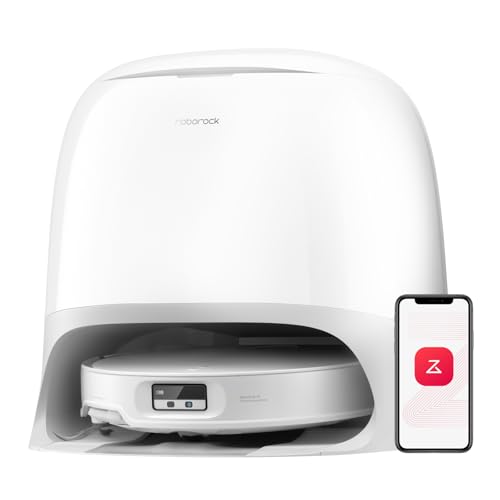
| Roborock Qrevo CurvXRoborock | Auto hot-water mop washing and drying | Source: Roborock Qrevo CurvX dock — manufacturer listing on Amazon.com (retrieved 2026-09-01) |
|---|
| Roborock Saros 10RRoborock | 10-in-1 Multifunctional Dock 4.0 with hot-water mop washing | Source: Roborock Saros 10R product page — dock (retrieved 2026-09-01) |
|---|
| Roborock Qrevo Curv S5XRoborock | Self-emptying, stated at ten weeks, with auto mop washing | Source: Roborock Qrevo Curv S5X dock — manufacturer listing on Amazon.com (retrieved 2026-09-01) |
|---|
| Roborock Qrevo ProRoborock | Dynamic hot-water mop washing with auto mop drying | Source: Roborock Qrevo Pro dock — manufacturer listing on Amazon.com (retrieved 2026-09-01) |
|---|
| Roborock Qrevo (QV 35A)Roborock | All-in-one dock with auto mop washing | Source: Roborock Qrevo QV 35A dock — manufacturer listing on Amazon.com (retrieved 2026-09-01) |
|---|
| Dreame X50 UltraDreame | Self-emptying, self-cleaning, all-in-one | Source: Dreame X50 Ultra dock — manufacturer listing on Amazon.com (retrieved 2026-09-01) |
|---|
| Dreame L40s UltraDreame | Auto-empty with mop self-cleaning | Source: Dreame L40s Ultra dock — manufacturer listing on Amazon.com (retrieved 2026-09-01) |
|---|
| Dreame X40 UltraDreame | Self-emptying with 158F mop and washboard self-cleaning, auto refill | Source: Dreame X40 Ultra dock — manufacturer listing on Amazon.com (retrieved 2026-09-01) |
|---|
| Dreame L10s UltraDreame | Auto mop cleaning and drying, self-refilling and self-emptying, stated at 60 days | Source: Dreame L10s Ultra dock — manufacturer listing on Amazon.com (retrieved 2026-09-01) |
|---|
| eufy X10 Pro Omnieufy | Self-emptying with auto mop washing and drying, 3L self-refilling tank | The robot itself carries an 80ml water tank.Source: eufy X10 Pro Omni product page — station and tanks (retrieved 2026-09-01) |
|---|
| ECOVACS DEEBOT T30S ComboECOVACS | All-in-one hub with dual self-emptying for the robot and the stick vacuum, plus hot-water mop washing | Source: ECOVACS DEEBOT T30S Combo station — manufacturer listing on Amazon.com (retrieved 2026-09-01) |
|---|
| iRobot Roomba Combo j9+iRobot | Multi-functional base that empties the bin and refills the mop tank, stated at up to 60 days | Source: iRobot Roomba Combo j9+ product page — base (retrieved 2026-09-01) |
|---|
| iRobot Roomba j9+iRobot | Self-emptying base, stated at 60 days | Source: iRobot Roomba j9+ base — manufacturer listing on Amazon.com (retrieved 2026-09-01) |
|---|
| iRobot Roomba Max 705 VaciRobot | AutoEmpty dock | Source: iRobot Roomba Max 705 dock — manufacturer listing on Amazon.com (retrieved 2026-09-01) |
|---|
| Shark PowerDetect 2-in-1 (AV2800ZE)Shark | NeverTouch Pro base — self-empty at a stated 60 days, refill, pad wash and dry | Source: Shark PowerDetect 2-in-1 base — manufacturer listing on Amazon.com (retrieved 2026-09-01) |
|---|
| Shark Matrix Plus 2-in-1Shark | HEPA bagless self-empty base, stated at 60 days | Source: Shark Matrix Plus 2-in-1 base — manufacturer listing on Amazon.com (retrieved 2026-09-01) |
|---|
| Shark PowerDetect Self-Empty (AV2820S)Shark | Bagless self-empty base, stated at 30 days, with HEPA filtration | Shark states the base holds "30 days of dirt and debris" and that its HEPA filtration "captures and traps 99.97% of dust and allergens".Source: Shark PowerDetect AV2820S product page — base (retrieved 2026-09-21) |
|---|
| Roborock Q7 M5+Roborock | Auto-empty dock with a 2.7L dust bag, stated at up to 7 weeks | Roborock qualifies the interval: "Based on Roborock internal testing. Actual results may vary depending on usage conditions." The Amazon listing title says 7 to 9 weeks.Source: Roborock Q7 M5+ product page — auto-empty dock (retrieved 2026-09-17) |
|---|
| iRobot Roomba 105 VaciRobot | AutoEmpty dock, stated at up to 75 days | Source: iRobot Roomba 105 Vac product page — dustbin and dock (retrieved 2026-09-13) |
|---|
| iRobot Roomba Max 715 PetiRobot | AutoEmpty dock with a sealed AllergenLock bag, stated at 90 days and 0.7 microns | Source: iRobot Roomba Max 715 product page — AutoEmpty dock (retrieved 2026-09-13) |
|---|
| eufy Omni C28eufy | Five-function Omni station: self-cleaning mop, auto hot-air drying, auto dust emptying, auto tank refilling and auto wastewater collection | Source: eufy Omni C28 product page — Omni station (retrieved 2026-09-13) |
|---|
| Dreame Aqua10 Ultra Roller CompleteDreame | Auto-empty stated up to 100 days, with 100C (212F) hot-water roller washing and hot-air drying | The wash temperature is the notable figure: 100C is boiling point, and it is the highest wash temperature any maker on this site states.Source: Dreame Aqua10 Ultra Roller Complete product page — dock (retrieved 2026-09-26) |
|---|
| Narwal Flow 2Narwal | Auto self-emptying into a 2.5L bag, stated up to 120 days, with mop washing at 113-176F and warm-air drying at 104F | The 120-day figure is the longest stated self-empty interval of any machine on this site. Narwal also states the base station washes at up to 212F.Source: Narwal Flow 2 product page — base station (retrieved 2026-09-26) |
|---|
| Shark AI Ultra Self-Empty (AV2501S)Shark | Bagless self-empty base, stated at 30 days, with true HEPA filtration | Shark states the base holds "up to 30 days of dirt and debris" and that its true HEPA filtration "captures and traps 99.97% of dust and allergens" down to 0.3 microns.Source: Shark AI Ultra AV2501S product page — self-empty base (retrieved 2026-10-03) |
|---|
| Narwal Freo Z10 TurboNarwal | Auto-washing, auto-drying and self-emptying, with stated wash temperatures of 45C for starch and 60C for grease plus a 72C pasteurization cycle | Narwal is the only maker we cover that states more than one wash temperature and ties each to a soil type. It does not state a self-empty interval for this model.Source: Narwal Freo Z10 Turbo product page — base station (retrieved 2026-10-03) |
|---|
| ECOVACS DEEBOT X9 PRO OMNIECOVACS | Self-emptying into a 3L bag, with temperature-controlled mop washing stated from 40C to 75C (104F to 167F) and hot-air drying | ECOVACS publishes a wash temperature RANGE rather than a single figure, and states selectable drying durations of 2, 3 or 4 hours.Source: ECOVACS DEEBOT X9 PRO OMNI product page — station (retrieved 2026-10-03) |
|---|
| eufy Omni S2eufy | 12-in-1 UniClean station: mop washing with electrolyzed water at a stated 60C, hot-air drying at a stated 55C, automatic detergent dispensing, self-emptying and waste-water collection | eufy publishes both temperatures as single figures rather than a range, which makes them checkable against the 40C to 75C range ECOVACS states.Source: eufy Omni S2 US product page — UniClean station (retrieved 2026-10-17) |
|---|
| eufy Omni E28eufy | Omni Station: self-emptying into a stated 3L bag for up to 75 days, self-washing, self-refilling, hot-air drying at a stated 35C to 50C, automatic detergent dispensing for up to 6 months, 2.5L clean and 1.8L waste tanks, and storage for the portable deep cleaner | Source: eufy Omni E28 product page — Omni Station (retrieved 2026-10-17) |
|---|
| eufy Omni C20eufy | All-in-One station: self-emptying into a stated 3.1L bag for up to 60 days in a pet-free home, mop washing, mop drying with room-temperature air, and water refilling from a 2.5L tank | Room-temperature drying rather than hot air. That is the single biggest difference between this station and the expensive ones, and it is the usual cause of a musty pad.Source: eufy Omni C20 product page — station (retrieved 2026-10-17) |
|---|