Disclosure — some links on this page go to Amazon, and we earn a commission if you buy through them. It costs you nothing extra and it does not change what we recommend or in what order. The full disclosure.
Vinyl plank is waterproof, so buy for the mop rather than against it. Look for a dock that washes and dries the pad, a brush that reaches into embossed grain, and a published mop lift if a rug shares the floor. A rinsing roller mop, wasted on laminate, is the right mechanism here.
Almost everything written about robot vacuums on wood-look floors is written about laminate, and it is mostly a list of warnings: use the lowest water setting, never let the robot park wet, check your seams. That advice is correct for laminate and largely wrong for luxury vinyl plank, because the two floors fail in completely different ways.
Why LVP changes the ranking
Laminate is a printed layer over a fiberboard core. Water that reaches that core through a seam swells it permanently, which is why the laminate page ranks on water control above almost everything else. Vinyl plank has no fiberboard in it. The plank itself is genuinely waterproof, which is why our own which floors can you mop table lists it as the most forgiving of the wood-look floors.
That single difference moves the mop from the risk column to the value column. On laminate the best robot is the one that mops most carefully. On LVP it is the one that mops most thoroughly — and a rinsing roller mop, which puts more water on the floor than a damp pad does and is therefore a poor fit for laminate, becomes the mechanism you actually want.
The dock is what you are actually buying
Because the floor tolerates a proper wet pass, the limiting factor becomes the pad rather than the plank. One pad dragged across a whole floor is dirty within the first room and redistributing by the second, and no amount of water pressure changes that. What changes it is a dock that washes the pad between passes, and — more important than it sounds — dries it afterwards so it does not go sour between runs.
What each dock does, in its maker's own words
6 of 6 models publish this figure. Every number below links to the page it came from.
Compiled from the manufacturers’ own published material — every row carries the date its figure was read. We have not measured any of these figures ourselves, see how we pick. Found an error? Tell us and we will correct it.
Read the Q7 M5+ row against the others. It is the cheapest machine here and its dock empties dust only — Roborock describes it as auto-empty, not mop-washing — so the pad is still yours to rinse by hand. That is a reasonable trade at its price, and it is a real gap on a floor where the mop is the main event. The full dock comparison across the site is in best robot vacuums with self-cleaning docks.
Pad or roller, on a floor that can take either
This is the one page on the site where the roller mop wins on its own terms rather than with caveats. A flat spinning pad collects dirt and carries it; a roller is scraped and rewetted continuously through the run, so the far end of a large floor gets roughly the same water as the near end. Its cost is that it puts more water down — which is exactly the objection that rules it out on laminate and does not apply here.
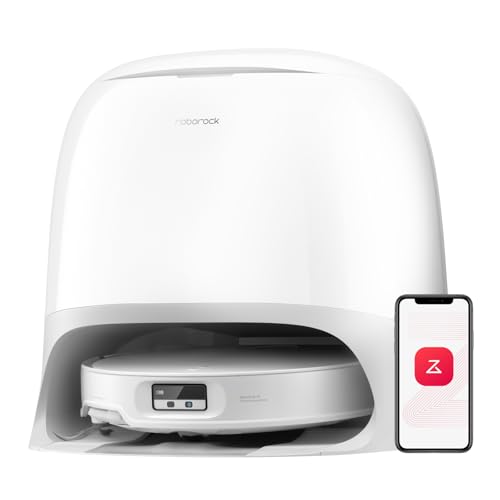
eufy's HydroJet roller on the Omni C28 is the clearest example in our registry, and it is the reason that machine leads this page rather than a more expensive flagship. The mechanism comparison in full, including where the pad is still the better answer, is on mop pad vs roller.
Embossed grain is the reason the brush still matters
Much vinyl plank is embossed to imitate timber, sometimes registered to the printed grain so the texture lines up with the pattern. It looks convincing and it holds fine grit in the low points, where a flat pad skims straight over the top. A roller or rubber-fin brush reaches into that texture; a stiff bristle brush tends to flick debris out of its own path on a hard surface instead of collecting it.
Published main brush construction
6 of 6 models publish this figure. Every number below links to the page it came from.
Compiled from the manufacturers’ own published material — every row carries the date its figure was read. We have not measured any of these figures ourselves, see how we pick. Found an error? Tell us and we will correct it.
The Roomba 105 Vac row is there as the counter-example rather than as a candidate: a Multi-Surface bristle brush is the construction least suited to both textured vinyl and pet hair, and iRobot makes no anti-tangle claim for it. The wider argument is on brush types for hardwood and tile.
Scratching, and the one real risk to the wear layer
Vinyl plank is softer than tile and its printed pattern sits under a clear wear layer, so the question people ask is whether a robot will scuff it. The machine itself is very unlikely to: rubber wheels, a body that clears the floor, a brush softer than the surface. What does cause marks on any hard floor is grit trapped under a wheel or a caster and dragged along the same line repeatedly — which is an argument for running the robot often rather than for keeping it off.
The exceptions worth knowing — a dock parked in one place on a soft finish, a caster that has picked up a stone, anything hard the robot pushes rather than collects — are covered in will a robot vacuum scratch your floor.
If your vinyl is dark
A large share of LVP sold is dark walnut or near-black, and dark floors have a failure mode that has nothing to do with cleaning. Cliff sensors work by bouncing infrared off the floor and reading the return; a very dark, matte surface can absorb enough of it that the robot reads solid floor as a drop and refuses to cross. No manufacturer publishes a reflectivity threshold, so there is no specification to check before buying.
It is worth knowing before you spend rather than after, and there are workarounds. Robot vacuums and dark floors has the mechanism and the fixes.
How we picked
Criteria first, products second. These are the things we ranked on, stated before anything is recommended.
Does the dock wash the pad? On a waterproof floor the mop stops being a liability and becomes the main job, so a dock that rinses and dries the pad matters more here than on any other surface.
Water control at the edges, because the plank is waterproof and the subfloor underneath it is not. What you are avoiding is standing water sitting at a seam or a wall edge, not dampness on the surface.
A brush that reaches into the grain. Much LVP is embossed to imitate timber, and a flat pad skims across texture that a roller or rubber-fin brush reaches into.
A published mop-lift height, if any rug shares the floor. The floor tolerates water; the rug does not.
Published figures generally. A maker that states its lift height and brush construction can be checked before you buy; one that does not is asking for trust.
What we did not do: test any of these machines. We do not own one, we do not have a lab, and nothing on this page is written as though we did. The full method.
Quick picks
Ranked on the published specifications below. Tap a row to jump to the full write-up.
#
Product
Best for
Mop lift
Price
1
eufy Omni C28A rinsing roller mop and a five-function dock at mid-range price — the mechanism the expensive machines charge a lot more for.
Roborock Qrevo CurvXThe highest published suction figure here paired with the highest published mop lift, which is the combination a mixed-floor home actually needs.
Roborock Q7 M5+The Q7 M5's LiDAR and anti-tangle hardware, plus the self-emptying dock the plain M5 does not come with — and a stated bag capacity to go with it.
HydroJet roller rinses itself during the run instead of only at the dock
A stated 15,000 Pa, which is a real figure rather than a multiple
Five-function station: mop washing, hot-air drying, dust emptying, tank refill and wastewater collection
What it does not
No published threshold height and no published mop-lift height
No published runtime, bin capacity or body height either
The roller is a consumable and eufy does not state a replacement interval
Who it is for
Hard floors that get genuinely dirty, on a budget that will not reach a flagship omni station.
Skip it if
Your home has thresholds or deep carpet. eufy publishes no climb height and no mop-lift height for this model, so you cannot check either before you buy.
It is the best self-emptying dock on this site and we recommend it elsewhere without hesitation. On vinyl plank it is the wrong purchase for one simple reason: it does not mop at all. LVP is the one wood-look floor that takes real water, and a dry pass leaves the film of footprints and kitchen grease that makes a plank floor look dull. Buying a vacuum-only flagship for this floor means paying flagship money to skip the job the floor is best suited to.
What to do if rugs share the floor
Most vinyl plank floors have at least one rug on them, and the rug is the part that does not tolerate water. That puts the published mop-lift height back at the top of the list — 17mm clears a low-pile rug, around 10mm clears little more than a flat mat, and pads that come off entirely at the dock remove the question rather than reducing it.
Published mop lift on the picks here
2 of 5 models publish this figure. Every number below links to the page it came from.
Compiled from the manufacturers’ own published material — every row carries the date its figure was read. We have not measured any of these figures ourselves, see how we pick. Found an error? Tell us and we will correct it.
Three of those five publish nothing, which on this page is the single most useful thing the table tells you. If a rug shares your vinyl, buy from the two that state a figure, or use a mop-only no-go zone in the app — it takes a minute and it does not depend on a number nobody published. The cross-brand version is mop lift height compared.
Questions people actually ask
+ What is the best robot vacuum for vinyl plank floors?
The eufy Omni C28, because its rinsing roller mop is the mechanism a waterproof floor can actually take advantage of, and its station washes and dries the roller between runs. If a rug shares the floor, the Roborock Qrevo CurvX is the safer pick — it publishes a 17mm mop lift, and eufy publishes no lift height for the C28.
+ Can a robot vacuum mop luxury vinyl plank?
Yes. LVP is the most forgiving of the wood-look floors because the plank is genuinely waterproof rather than merely water-resistant, so a damp robot mop is not the risk it is on laminate. What you still avoid is standing water at a seam or an expansion gap, which mostly means not letting the robot park wet on the floor.
+ Will a robot vacuum scratch vinyl plank?
The machine itself is very unlikely to — rubber wheels, a soft brush and a body that clears the floor. The realistic risk on any hard floor is grit caught under a wheel and dragged repeatedly, which is an argument for running it regularly. Keep the dock off a spot you care about and check the casters occasionally.
+ Is vinyl plank different from laminate for a robot vacuum?
For vacuuming, no — debris sits on the surface of both. For mopping, completely. Laminate has a fiberboard core that swells if water reaches it through a seam, so it rewards careful, low-water mopping. Vinyl plank has no such core, so it rewards a thorough wet pass and a dock that washes the pad.
+ Do I need a roller mop for vinyl plank?
You do not need one, but this is the floor where it makes most sense. A roller is rinsed continuously during the run, so the far end of a big floor gets cleaner water than a single dragged pad delivers. Its drawback — more water on the floor — is the objection that rules it out on laminate and does not apply to waterproof vinyl.
+ Why does my robot vacuum stop at my dark vinyl floor?
Almost certainly the cliff sensors. They read infrared bounced off the floor, and a very dark matte surface can absorb enough of it that the robot reads a drop-off and refuses to cross. No maker publishes a reflectivity figure, so it cannot be checked before buying. Our dark floors page covers the workarounds.