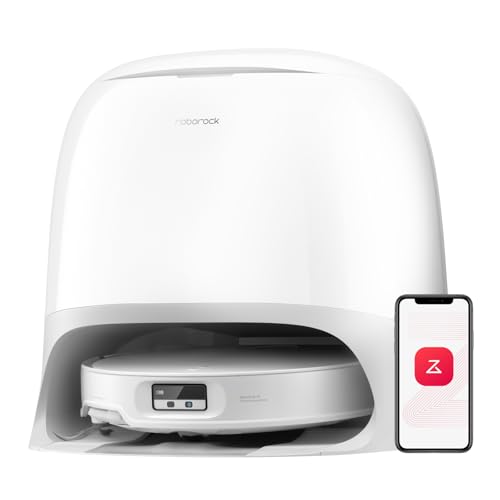
Every other brand comparison on this site runs into a wall of unpublished figures. This one does not — which makes it the only pairing you can actually settle on specifications.
Disclosure — some links on this page go to Amazon, and we earn a commission if you buy through them. It costs you nothing extra and it does not change what we recommend or in what order. The full disclosure.
Dreame publishes a climb height for three of the four models it currently sells here; Roborock publishes one for one of its six. Roborock publishes the higher mop lift (17mm against 10.5mm) and the only body heights. Dreame publishes the only runtimes and bin capacities. Buy Dreame for thresholds, Roborock for low furniture and documented brush hardware.
Most brand comparisons in this category collapse quickly, because at least one side will not tell you anything. Shark vs Roomba has two full rows blank on both sides. Roborock vs Roomba is really a comparison between a company that prints pascals and one that prints multiples of an unnamed baseline.
Dreame against Roborock is different, and it is the reason this page is worth writing. Both makers state a suction figure for every model they sell. Both describe their brushes. Both publish enough that you can put the two spec sheets side by side and have an argument about the contents rather than about the gaps. It is the only pairing on this site where that is true.
So where does each one go quiet?
Both brands leave rows blank. What is interesting is that they leave different ones blank, and the pattern is consistent enough to look deliberate.
Rows published across each brand's currently-purchasable range
Specification
Dreame (4 models)
Roborock (6 models)
Suction in pascals
4 of 4
6 of 6
Climb / threshold height
3 of 4
1 of 6
Mop lift height
2 of 4
2 of 6
Main brush construction
3 of 4
5 of 6
Navigation system stated
1 of 4
5 of 6
Runtime
2 of 4
0 of 6
Dustbin capacity
1 of 4
0 of 6
Body height
0 of 4
2 of 6
Counted across the models each brand currently has in stock and featured on this site, from the figures on their own product pages and listings. Every underlying row is sourced on the model's own page.
Read down that table and a shape appears. Dreame publishes what the robot achieves — how high it climbs, how long it runs, how much it holds. Roborock publishes what the robot is — how tall the body is, which navigation system is inside it, how far the mop lifts. Neither is more honest than the other. They are answering different questions, and which set you need depends entirely on your house.
Climb height: Dreame's clearest win, and it is not close
This is the specification this whole site was built around, because it is the one that decides whether a robot can reach a room at all. A machine that cannot get over the strip between your kitchen and your hall does not clean your hall, and no amount of suction changes that.
Published climb height, Dreame and Roborock
4 of 10 models publish this figure. Every number below links to the page it came from.
60mm over a series of steps, 42mm over a single step
Dreame's own condition, quoted: "The gap between steps should be greater than 4cm. For a single obstacle crossing and a single vertical step, the highest obstacle crossing height is 4.2cm." The 6cm headline therefore does not describe a single door sill.Source: Dreame X50 Ultra product page — ProLeap step climbing (retrieved 2026-09-01)
Compiled from the manufacturers’ own published material — every row carries the date its figure was read. We have not measured any of these figures ourselves, see how we pick. Found an error? Tell us and we will correct it.
Three filled rows against one. Dreame states a figure for the X50 Ultra, the L40s Ultra and the X40 Ultra, three of the four models it currently sells here, and the X50's 60mm over a series of steps is the highest published climb figure of any robot vacuum on this site. Roborock states 40mm for the Qrevo CurvX and nothing for the other five — including the Saros 10R, which is the most expensive machine on this site.
Mop lift: Roborock's number is higher, Dreame's mechanism is better
Published mop lift, Dreame and Roborock
4 of 6 models publish this figure. Every number below links to the page it came from.
Compiled from the manufacturers’ own published material — every row carries the date its figure was read. We have not measured any of these figures ourselves, see how we pick. Found an error? Tell us and we will correct it.
Roborock's 17mm on the CurvX and the Saros 10R is the highest published lift on this site, and 17mm clears a low-pile rug where Dreame's 10.5mm clears little more than a flat mat. On the raw number Roborock wins.
The X40 Ultra complicates that, because its pads come off entirely rather than rising. A raised wet pad is still a wet pad hovering over a carpet the robot is about to drive across; a removed pad is not on the machine. For a genuinely mixed house that is a categorical difference rather than a few millimeters, and it is why the X40 outranks machines with bigger numbers on our mop combo roundup.
Suction: both publish, and it settles less than you would think
Published peak suction, Dreame and Roborock
10 of 10 models publish this figure. Every number below links to the page it came from.
Compiled from the manufacturers’ own published material — every row carries the date its figure was read. We have not measured any of these figures ourselves, see how we pick. Found an error? Tell us and we will correct it.
At the top the two brands are within touching distance — 22,000 Pa against 20,000 Pa — and since there is no shared standard behind a pascal figure, that gap is inside the noise. The bottoms of the two ranges are further apart and further down than most buyers expect: Roborock's cheapest current trims publish 7,000 Pa and 8,000 Pa, and Dreame's L10s Ultra publishes 5,300 Pa, the lowest figure in this comparison. Both brands sell machines whose stated suction is a third of their own flagship's.
That does not make the cheap Roborocks bad buys — the Qrevo Pro's hot-water washing dock at its price is one of the best value propositions on this site. It does mean that if you are shopping on the suction figure specifically, Dreame's floor is higher than Roborock's. The full cross-brand context is in the suction power chart, including why we keep telling people this number matters less than they think.
Brush and navigation: Roborock documents these better
Published main brush construction
7 of 8 models publish this figure. Every number below links to the page it came from.
Compiled from the manufacturers’ own published material — every row carries the date its figure was read. We have not measured any of these figures ourselves, see how we pick. Found an error? Tell us and we will correct it.
Roborock describes mechanisms. DuoDivide splits the roller in two with spiral blades between them; JawScrapers is a fixed comb held against the roller; FlexiArm is a side brush that extends into the corner. Those are descriptions you could evaluate or disagree with.
Dreame names things. The L40s Ultra's DuoBrush is "100 percent detangling" with no mechanism attached, which is a claim rather than a specification. The X40 Ultra's entry is "liftable brushes with an extending side brush" — useful, but lifting is not an anti-tangle feature and Dreame makes no anti-tangle claim for that model at all. Only the X50 Ultra's HyperStream Detangling DuoBrush names both the function and the design.
The side brush follows the same pattern and matters more than people expect, because it is the part long hair winds around worst. Roborock addresses it explicitly on the CurvX and the Curv S5X. Dreame addresses extension rather than tangling. If something in your house sheds, that gap is the tiebreaker — the argument in full is on rubber vs bristle brushes.
Navigation is the same story again: Roborock states a navigation system on five of six models — RetractSense, StarSight 2.0, Reactive Tech, 360-degree LiDAR — while Dreame names one on one of three, leaving the L40s Ultra and the X40 Ultra as "not named on the listing". What each approach actually buys you is on LiDAR vs vSLAM.
The two rows only Dreame fills
Roborock publishes no runtime and no bin capacity for any of the six models we cover. Dreame publishes both, and they are the figures that decide whether a machine finishes a large floor in one go.
Runtime and capacity — figures Roborock does not publish at all
Model
Stated runtime
Stated dustbin
Dreame X50 Ultra
Up to 220 minutes
395ml on board, 3.2L dock bag
Dreame X40 Ultra
Up to 198 minutes
Not published
Dreame L40s Ultra
Not published
Not published
Every Roborock here
Not published
Not published
Read stated runtimes with the usual caution: they are quoted in the quietest mode on the easiest surface. Battery life and runtime compared explains how far off a real carpeted run tends to be.
How we picked
Criteria first, products second. These are the things we ranked on, stated before anything is recommended.
Count the filled rows across each brand's whole range, not just its flagship. A brand that publishes everything for its halo model and nothing below it is harder to shop than one that publishes consistently.
Compare only where both makers publish. Where one is blank we say so and move on rather than filling the gap with a reviewer's measurement or an estimate of our own.
Weigh millimeters above pascals. A climb height and a mop lift are physical dimensions that compare honestly between brands. A Pa figure is measured by each maker's own method with no shared standard, so it ranks within a brand and only roughly across them.
Credit described mechanisms over trademarked names. "DuoDivide splits the roller in two with spiral blades between them" is checkable. "100 percent detangling" is not.
No durability, reliability or service claims in either direction. We have not run these machines for years and will not pretend to know how they age.
What we did not do: test any of these machines. We do not own one, we do not have a lab, and nothing on this page is written as though we did. The full method.
Quick picks
Ranked on the published specifications below. Tap a row to jump to the full write-up.
#
Product
Best for
Suction
Price
1
Roborock Qrevo CurvXThe highest published suction figure here paired with the highest published mop lift, which is the combination a mixed-floor home actually needs.
Dreame X50 UltraThe only model here that legs itself over a step rather than driving at it, and the only one that publishes the condition attached to its own headline number.
Dreame L40s UltraStates 40mm of obstacle clearing and a fully detangling brush, which covers the two problems that actually send robots back to the shop.
The only model here that legs itself over a step rather than driving at it, and the only one that publishes the condition attached to its own headline number.
60mm over a series of steps, 42mm over a single stepDreame's own condition, quoted: "The gap between steps should be greater than 4cm. For a single obstacle crossing and a single vertical step, the highest obstacle crossing height is 4.2cm." The 6cm headline therefore does not describe a single door sill.Source: Dreame X50 Ultra product page — ProLeap step climbing (retrieved 2026-09-01)
Publishes the caveat as well as the headline, which is rarer than it should be
20,000 Pa stated peak suction and a 395ml on-board bin
Stated 220 minutes of runtime in quiet mode
What it does not
The legs add height and mechanical complexity to a machine that lives under furniture
10.5mm mop raise is modest next to the 17mm figures from Roborock
Who it is for
Split-level rooms, a sunken living room, or a doorway sill that has beaten every robot you have owned.
Skip it if
You read the 6cm headline and stopped there. Dreame's own footnote puts a single vertical step at 42mm, and 6cm only applies to a series of steps with more than 4cm between them.
It has anti-tangle main and side brushes and an all-in-one washing dock, which is a real package. It is the skip on this page because it is the weakest spec sheet in the comparison from the brand this page otherwise praises for publishing: 8,000 Pa, no climb height, no mop lift, and a navigation system Roborock describes only as smart obstacle avoidance without naming it. It has also drifted up into the same bracket as the Dreame X40 Ultra and the Roborock Qrevo Curv S5X, both of which publish considerably more. Check the live prices on the buttons below before you decide — but on published data this is the one to pass over.
Which one should you actually buy?
Buy Dreame if your house has thresholds you have measured, if you need to know how long the machine runs before it gives up, or if you want a published climb figure without paying flagship money. It is also the brand to take if you want the mop pads gone rather than raised.
Buy Roborock if your problem is furniture rather than door sills — it is the only one of the two publishing a body height, and 80mm is the difference between reaching under a sofa and stopping at it. Take it too if something sheds, because its brush and side-brush hardware is described in enough detail to be worth trusting, and if you want a mop that lifts high enough to cross a low-pile rug.
And if the budget is genuinely tight, the honest answer is Roborock's Q7 M5, which is the cheapest machine on this entire site that still publishes a real pascal figure and a named anti-tangle brush. It publishes no climb height, so measure your sills before you commit to it.
Questions people actually ask
+ Is Dreame better than Roborock?
Neither is better across the board, and unusually for this category both publish enough to say why. Dreame states a climb height for three of its four current models and the only runtimes and bin capacities. Roborock states the higher mop lift, the only body heights, and describes its brush and navigation hardware in more detail. Choose on which of those your house actually needs.
+ Which brand climbs higher thresholds?
Dreame, clearly. Its X50 Ultra publishes 60mm over a series of steps and 42mm over a single step — the highest figures on this site — and its L40s Ultra matches Roborock's best published figure of 40mm from a cheaper machine. Roborock publishes a climb height for only one of the six models we cover.
+ Which brand is better for pet hair?
Roborock, on published hardware. It describes what its anti-tangle brushes actually do rather than naming them, and it addresses the side brush — the part long hair winds around worst — on more than one model. Dreame's strongest brush claim is on the X50 Ultra; its other two describe lifting or state a percentage without a mechanism.
+ Is 22,000 Pa much better than 20,000 Pa?
No. There is no shared standard for measuring pascals, so a 10 percent gap between two different manufacturers is well inside the measurement noise. The suction figure ranks models within a single brand's range reasonably well and across brands only roughly. Climb height and mop lift, being millimeters, compare honestly.
+ Does Roborock publish runtime?
Not for any of the six models we cover. Dreame publishes up to 220 minutes for the X50 Ultra and up to 198 minutes for the X40 Ultra. Bear in mind every maker quotes runtime in the quietest mode on hard floor, so a carpeted run at full suction will be substantially shorter whichever brand you buy.
+ Which is better value?
It depends on which figure you are buying. Dreame's cheapest current model publishes more suction and a climb height that Roborock's similarly priced trims do not. Roborock covers far more price points and the Q7 M5 is the cheapest machine on this site publishing a real suction figure and a named anti-tangle brush. Check the live prices on the buttons above, which move constantly.