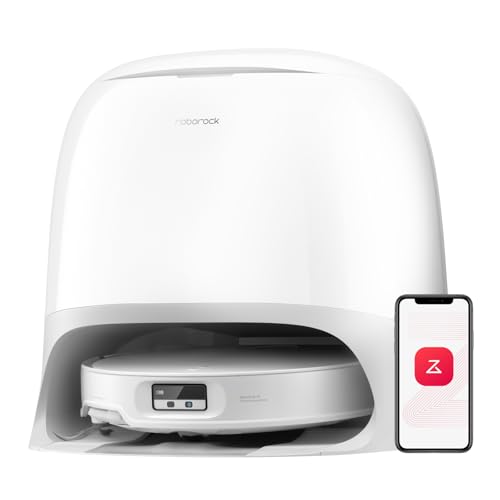
Two brands, three price tiers, one structural difference: one of them tells you the numbers and the other tells you how many times better it is than something it will not name.
Disclosure — some links on this page go to Amazon, and we earn a commission if you buy through them. It costs you nothing extra and it does not change what we recommend or in what order. The full disclosure.
Roborock publishes suction in Pascals, climb height in millimeters and mop lift in millimeters across its range. iRobot publishes brush construction and dock behavior clearly, but states suction as a multiple of an unnamed baseline on most models. At matching prices Roborock gives you more checkable specification; iRobot gives you a retracting mop and a sealed allergen bag nobody else offers.
This is the comparison people actually run, and it is usually run on the wrong axis — brand reputation, or which one a friend owns. The useful axis is narrower and more boring: at the price you are going to spend, which machine can you check before you buy it?
The structural difference
Roborock states a Pascal figure for every model it sells. Dreame does the same, eufy does the same. iRobot, for most of its range, does not. It says seventy times more power-lifting suction on the 105, four times more on the Max 715, one hundred percent stronger than the Combo i series on the j9+ — each a multiple of a baseline that is never identified.
You cannot compare a multiple with a Pascal. You cannot even compare iRobot's multiples with each other, because there is no reason to assume the baselines are the same machine. This is not an accusation of dishonesty — the claims may be perfectly accurate — it is an observation that they are unfalsifiable, and this site ranks on what can be checked.
Entry tier: around $150 to $250
Roborock's Q7 M5 and iRobot's Roomba 105 Vac are the two cheapest mapping robots either brand sells, and they are a clean illustration of the whole argument.
Entry tier, head to head
Roborock Q7 M5
iRobot Roomba 105 Vac
Stated suction
10,000 Pa
A multiple, no figure
Main brush
JawScrapers Comb anti-tangle
Multi-Surface bristle
Navigation
360-degree LiDAR, multi-level mapping
ClearView LiDAR, up to 3 maps
Self-empty interval
Stated 7 to 9 weeks
Stated up to 75 days
Mops
Yes
No
Both publish a navigation system and a dock interval. Only one publishes a suction figure and an anti-tangle brush.
For a shedding household this is not close. The bristle brush is the construction that winds hair into a collar, and iRobot makes no anti-tangle claim for the 105 at all — the reason it is the named skip on our pet hair roundup. For a hard-floor flat with nobody shedding in it, the 105's three saved maps and 75-day dock are a genuinely good package.
Middle tier: around $600
This is the most interesting comparison on the page, because the Roborock Qrevo Curv S5X and the iRobot Roomba Max 715 Pet sit at almost exactly the same price and are built around opposite priorities.
Middle tier, head to head
Roborock Qrevo Curv S5X
iRobot Roomba Max 715 Pet
Stated suction
18,500 Pa
30,000 Pa (on the listing)
Main brush
Zero-tangling with FlexiArm side brush
Dual rubber anti-tangle plus anti-tangle side brush
The Roborock mops and washes its own pad; the Roomba does not mop at all. Against that, the Roomba is the better vacuum on paper and has the better bag — a sealed allergen bag rated to 0.7 microns is something no Roborock in our registry offers, and in a house where somebody reacts to dander it outranks the mop. Neither publishes a climb height, which is a mark against both.
Flagship tier: $800 and up
At the top the gap widens rather than closing. The Roborock Qrevo CurvX publishes 22,000 Pa, a 40mm double-layer climb, a 17mm mop lift, an 80mm body height and named anti-tangle hardware at both brushes. The Roomba Combo j9+ publishes a brush construction, a navigation system, an 86mm height and a dock interval — and for suction, that it is one hundred percent stronger than a previous generation.
The j9+ does have the single cleverest mop mechanism in the category: the pad retracts onto the top of the robot rather than lifting a few millimeters, so on carpet it is genuinely out of the way rather than hovering. If that specific problem is your problem, it is the machine that solves it. It is also, at this price, the model with the thinnest published spec sheet on the page, which is why it is the skip below.
What each brand is actually better at
Roborock: published figures across the whole range, the highest mop lifts, the only published climb heights of the two, and cheaper hardware at every tier. If you want to compare a machine against a table before buying, this is the brand that makes it possible.
iRobot: the retracting mop, the sealed allergen bag, a longer-established service and parts network, and an app most people find easier. It also, on the Max models, fits genuinely good anti-tangle hardware and is one of only two makers on this site to address the side brush as well as the roller.
How we picked
Criteria first, products second. These are the things we ranked on, stated before anything is recommended.
Compare at matching prices, not matching model numbers. A brand's flagship is only interesting against the other brand's flagship.
Count what each maker publishes: suction in Pascals, climb height in millimeters, mop lift, brush construction, navigation system. Five rows, checkable.
Treat a relative claim as a blank. Seventy times more suction than an unnamed baseline is a marketing unit, not a specification, and cannot be compared with anything.
Give credit for mechanisms the other brand does not have, whichever way it runs — iRobot's retracting mop and sealed allergen bag are real advantages.
Ignore brand heritage entirely. iRobot invented this category, which tells you nothing about what is in the box in 2026.
What we did not do: test any of these machines. We do not own one, we do not have a lab, and nothing on this page is written as though we did. The full method.
Quick picks
Ranked on the published specifications below. Tap a row to jump to the full write-up.
#
Product
Best for
Suction
Price
1
Roborock Qrevo CurvXThe highest published suction figure here paired with the highest published mop lift, which is the combination a mixed-floor home actually needs.
iRobot Roomba Max 715 PetDual rubber anti-tangle brushes and a 90-day allergen-sealed dock — and the one place iRobot has printed an actual suction number instead of a multiple.
iRobot Roomba 105 VaciRobot's entry machine, and the first cheap one with real LiDAR — but it keeps the bristle brush, which is the wrong brush for a shedding household.
Dual rubber anti-tangle brushes and a 90-day allergen-sealed dock — and the one place iRobot has printed an actual suction number instead of a multiple.
It is iRobot's flagship and it does one genuinely distinctive thing — the mop retracts onto the top of the robot, so it is physically off the floor rather than raised above it. But at four figures it still publishes no suction figure, stating only that it is one hundred percent stronger than the Combo i series, and no climb height at all. The Roborock flagship costs less, publishes both, and publishes a mop lift as well. If you are spending this much, spend it where the spec sheet is complete.
The answer, if you want one
At every price point here, Roborock publishes more of what you need to make the decision, and that is the basis this site recommends on. If your house sheds and somebody in it has allergies, the Roomba Max 715 Pet is the exception worth making — buy it for the bag, not for the suction claim.
If the underlying question is whether the Roomba name is worth the premium at all, that is a slightly different question and it has its own page: is a Roomba worth it.
Questions people actually ask
+ Is Roborock better than Roomba?
On published specifications, yes, at every price tier compared here — Roborock states suction in Pascals, climb height in millimeters and mop lift in millimeters, while iRobot mostly states multiples of an unnamed baseline. On hardware, iRobot has two things Roborock does not: a mop that retracts onto the top of the robot, and a sealed allergen bag rated to 0.7 microns.
+ Why does iRobot not publish suction in Pascals?
It has not said why, and we are not going to guess. What is observable is that it states relative multiples — seventy times, four times, one hundred percent stronger — without naming the baseline, and that the one model carrying a real 30,000 Pa figure carries it on its Amazon listing rather than on iRobot's own product page.
+ Which is better for pet hair, Roborock or Roomba?
It depends which model. iRobot's Max range fits dual rubber anti-tangle brushes and addresses the side brush too, which is excellent. Its entry 105 fits a bristle brush, which is the worst construction for hair. Roborock fits an anti-tangle design across the whole range, so the brand is more consistent even where individual Roombas beat it.
+ Is a Roomba worth the extra money?
At the entry and flagship tiers the Roborock equivalent costs less and publishes more, so the premium is buying brand, app and service rather than specification. In the middle, the Max 715 Pet at around $600 is genuinely competitive and its sealed allergen bag has no Roborock equivalent in our registry.
+ Do Roborock robots last as long as Roombas?
We have no basis to answer that. We have not run either brand for years and we do not publish durability claims we cannot source. What we can say is that iRobot has a longer-established parts and service network in the US, which is a reasonable thing to weigh if you keep appliances a long time.
+ Which brand climbs higher thresholds?
Roborock, among the models compared here — it publishes a 40mm double-layer figure for the Qrevo CurvX, while iRobot publishes no climb height for any model on this site. That does not mean Roombas climb badly; it means you cannot check before buying. Our threshold table shows every published figure across all brands.